Florham Biology Student Gianna Buscarino Earns First Place at ICUNJ Symposium; Five FDU Students Awarded ICUNJ Undergraduate Research Grants
Gianna Buscarino won first place at the 2026 Independent Colleges and Universities of New Jersey Undergraduate Research Symposium for the best presentation. The event took place at Bell Works, March 23.
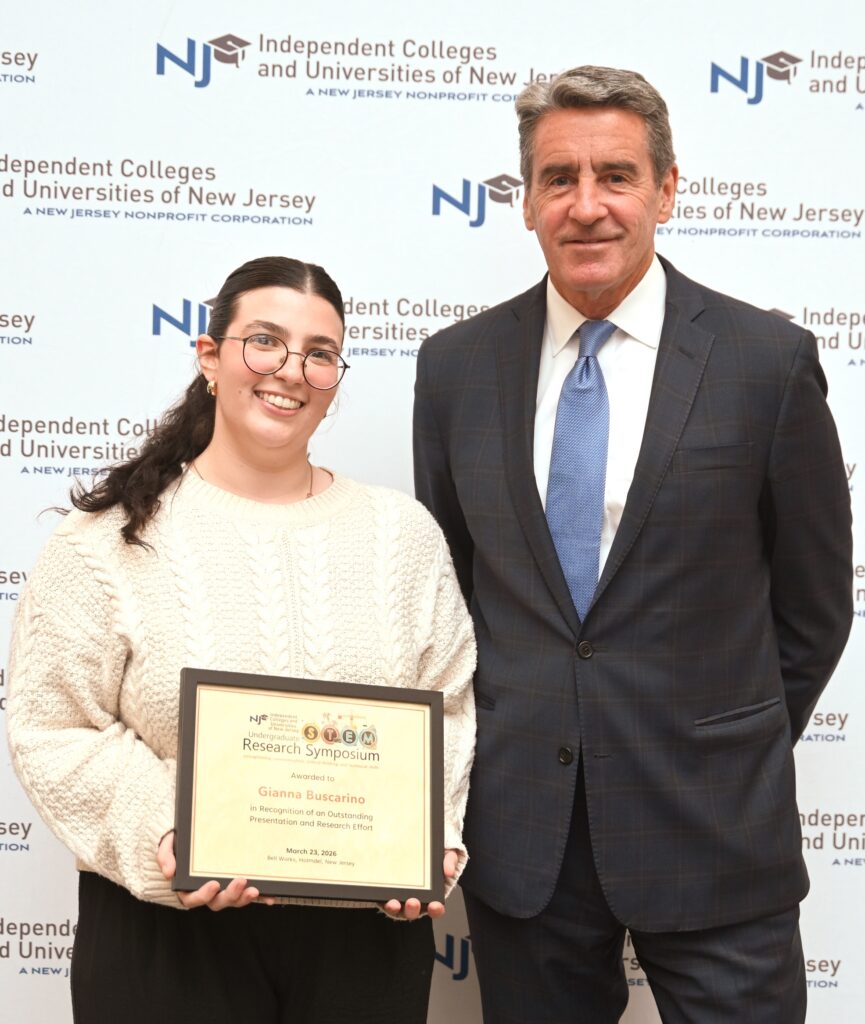
Gianna Buscarino holds her certificate for Best Presentation, and stands next to ICUNJ President & CEO Steve Reynolds.
A biology major with a concentration in cell and molecular biology at the Florham Campus who is minoring in chemistry, criminology, and forensics, Buscarino has been awarded a Schering-Plough Undergraduate Research Endeavors Grant from the Independent Colleges of New Jersey (ICUNJ). Four additional students from the Department of Biochemistry, Chemistry and Physics, Florham earned awards: Alyssa Grant and Hrithika Subramanian earned a grant from Schering-Plough and Dr. Scholl’s for their work with Dr. Robert Barrows. Sofia Vaina won a grant from Novartis for her work with Dr. Justin Bogart, and Melanie Perez won a grant from Nokia Bell Labs for her work with Dr. Guolong Zhu. The ICUNJ grants, in addition to Olsen College Grant in Aid awards to their faculty mentors, funded essential supplies students used to complete their projects.
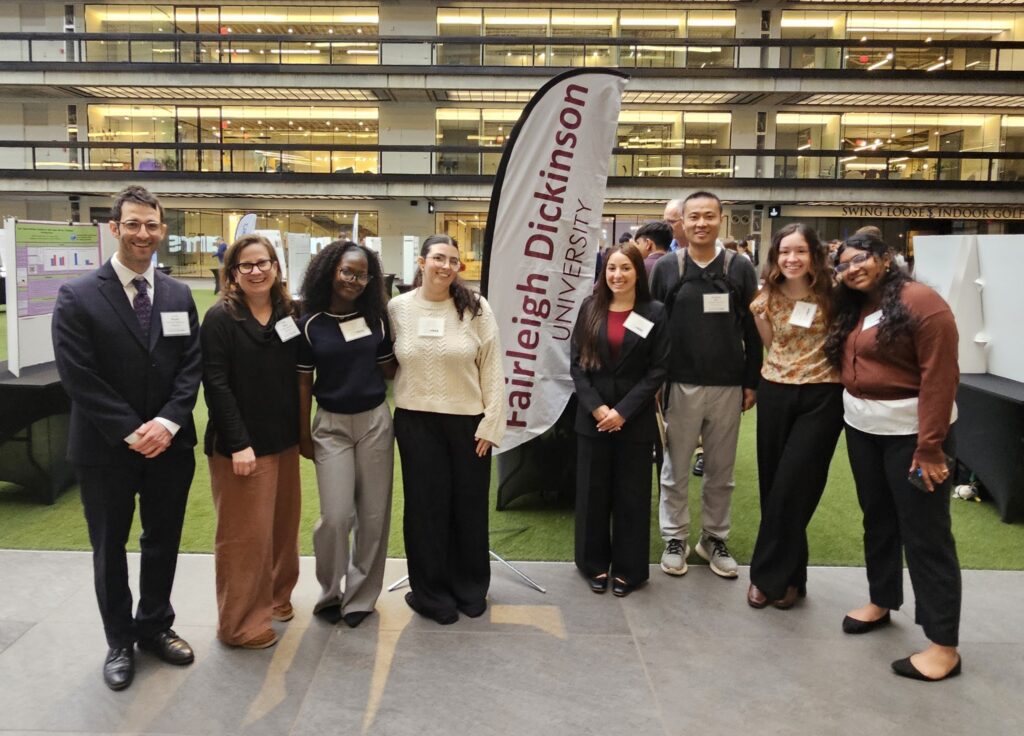
Pictured (from left): Dr. Justin Bogart, Dr. Edith Myers, Alyssa Grant (Barrows lab), Gianna Buscarino (Myers lab), Sofia Vaina (Bogart lab), Dr. Guolong Zhu, Melanie Perez (Zhu lab), and Hrithika Subramanian (Barrows lab). Not pictured: Dr. Robert Barrows.
Buscarino’s research project was titled “Analyzing the Effects of Sulforaphane on Alpha-Synuclein Aggregation in a C. elegans Model of Parkinson’s Disease.” Under the mentorship of Dr. Edith M. Myers, Associate Professor and Deputy Department Chair in the Department of Biological Sciences at Florham, Buscarino is investigating the potential neuroprotective benefits of sulforaphane—a naturally occurring compound found in cruciferous vegetables such as broccoli—in reducing the aggregation of alpha-synuclein protein, a key pathological hallmark of Parkinson’s disease. Her work is also culminating in an honors thesis.
One of the primary markers of neurodegenerative diseases like Parkinson’s is the formation of Lewy bodies in the brain, composed largely of aggregated alpha-synuclein. In high quantities, this protein can trigger neurodegeneration. While prior studies have shown sulforaphane’s neuroprotective effects in C. elegans, no research had directly examined whether sulforaphane itself inhibits aggregation. Buscarino’s project addresses this gap using the model organism C. elegans. Gianna will be entering the PhD program in Cell and Molecular Biology at Rowan University this fall, and plans to continue in a career in biological research.