Laboratory Safety Practices and Control Measures
Laboratory safety practices and control measures are designed to minimize hazards and protect faculty, staff, students, visitors, and other authorized personnel. The University uses the Hierarchy of Controls to identify and implement effective methods for eliminating or reducing laboratory risks.
The LSP establishes general laboratory safety requirements. Additional requirements may apply under the University’s Chemical Hygiene Plan, Biosafety Plan, Radiation Safety Program, Cryogenic Materials Safety Program, Compressed Gas Safety Program, Respiratory Protection Program and other applicable EHS programs.
Hierarchy of Controls
The University uses the recognized Hierarchy of Controls to identify the most effective methods for reducing laboratory hazards.
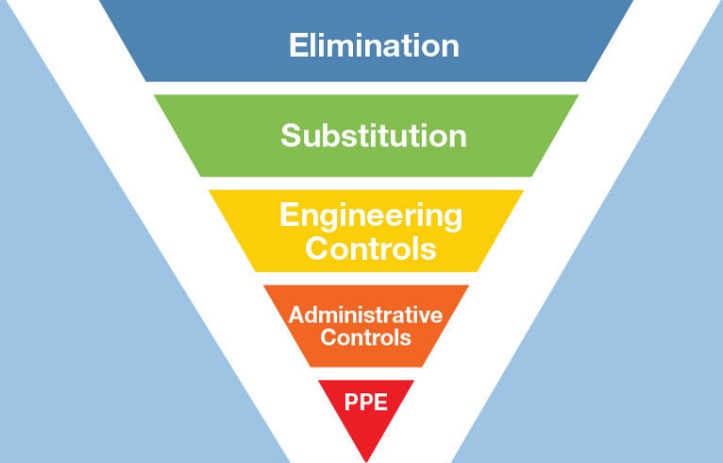
- Elimination – Remove the hazard from the process.
- Substitution – Replace the hazard with a safer material, process, or method.
- Engineering Controls – Physically isolate personnel from hazards through systems such as ventilation, guards, shielding, and containment.
- Administrative Controls – Reduce risk through policies, SOPs, training, supervision, signage, access controls, inspections, and safe work practices.
- Personal Protective Equipment (PPE) – Protect personnel from residual hazards when other controls cannot adequately eliminate or reduce the risk.
Controls should be selected in accordance with the hierarchy, with emphasis placed on eliminating or controlling hazards at their source before relying on administrative controls or PPE.
Engineering Controls
Engineering controls are physical systems designed to isolate personnel from hazards or reduce exposure at the source. Examples include:
- Laboratory ventilation and HVAC systems
- Fume hoods and local exhaust systems
- Safety shields, barriers, guards, and containment systems
- Gas detection and oxygen-deficiency monitoring systems
- Other engineered safeguards identified through laboratory hazard assessments
Administrative Controls
Administrative controls establish safe operating expectations and include:
- SOPs
- Safety training and competency requirements
- Hazard warning signs and labeling
- Laboratory access and authorization requirements
- Safe work practices and supervision
- Inspection, maintenance, and housekeeping programs
- Incident reporting and corrective actions
Personal Protective Equipment
PPE is the final level of protection and shall be selected based on the hazards associated with the laboratory, task, equipment, and materials. PPE shall:
- Be selected through a hazard assessment and, where applicable, chemical compatibility evaluation.
- Meet applicable regulatory and consensus standards.
- Be properly fitted, used, maintained, inspected, and replaced.
- Be supported by appropriate training.
- Be used in conjunction with engineering and administrative controls rather than as a substitute for them.
Essential Laboratory PPE
Essential laboratory PPE consists of the minimum personal protective equipment necessary to protect laboratory personnel from chemical, biological, physical, radiological, thermal, mechanical, and other workplace hazards that cannot be adequately controlled through engineering or administrative controls. PPE shall be selected based on the specific hazards associated with the laboratory, procedure, equipment, materials, and tasks being performed.
Laboratory PPE may include safety glasses or goggles, laboratory coats or protective garments, appropriate gloves, and closed-toe, protective footwear. Additional PPE may be required based on the laboratory-specific hazard assessment, applicable regulations, or established SOPs.
The primary categories of laboratory PPE include:
- Body Protection – Protects skin and personal clothing from contamination, chemical exposure, biological agents, heat, and other hazards. (e.g., laboratory coats, chemical-resistant aprons, and other protective garments appropriate to the hazard)
- Eye and Face Protection – Protects the eyes and face from chemical splashes, biological materials, flying particles, impact hazards, thermal hazards, and other potentially injurious exposures. (e.g., safety glasses with side protection, chemical splash goggles, and full-face shields)
- Hand Protection – Protects against chemical and biological contact, cuts, punctures, abrasions, thermal hazards, and other task-specific hazards. Gloves shall be selected based on the material and hazard involved and shall not be considered interchangeable for all laboratory applications. (e.g., nitrile, neoprene, chemical-resistant, cryogenic, heat-resistant, and cut-resistant gloves)
- Respiratory Protection – Protects against inhalation of hazardous airborne contaminants when such exposure cannot be adequately controlled through elimination, substitution, engineering controls, or administrative controls. Respiratory protection shall only be used when required. (e.g., filtering facepiece respirators and other NIOSH-approved respirators appropriate to the identified hazard)
- Foot Protection – Protects against chemical and biological contamination, spills, falling objects, punctures, thermal hazards, and other laboratory-specific risks. Laboratory personnel shall wear closed-toe, substantially constructed footwear appropriate for the work being performed. Additional protective footwear may be required for specific hazards or activities.
- Hearing Protection – Protects against hazardous noise generated by laboratory equipment, machinery, processes, or other activities when noise exposure may exceed applicable occupational exposure limits. (e.g., earplugs and earmuffs)
- Specialized PPE – Additional PPE may be required for specific laboratory hazards or activities, including but not limited to cryogenic materials, lasers, ultraviolet or other non-ionizing radiation, ionizing radiation, high-temperature equipment, compressed gases, infectious or potentially infectious materials, sharps, and mechanical hazards. Specialized PPE shall be identified through the applicable hazard assessment, SOPs, laboratory-specific safety requirements, or other University safety programs.
- PPE shall be properly selected, used, maintained, inspected, and replaced as necessary. Laboratory personnel shall receive appropriate training on the limitations, proper use, donning and doffing, storage, cleaning, and disposal of PPE. PPE requirements shall be reviewed whenever laboratory operations, materials, equipment, or hazards change.