ChartSmart Lab: Preparing Students for the Future
ChartSmart Lab, a new specialized learning environment, is transforming how future healthcare professionals prepare for the modern medical workforce. The immersive lab gives nursing and allied health students essential, hands-on training across two critical pillars of modern healthcare delivery: electronic health records (EHRs) and telehealth.
According to Francesca Martinez, nursing and director of clinical laboratories, nursing/allied health (Metro), technology is no longer separate from standard practice. “Electronic health record training helps students learn how technology integrates directly into patient care — from documenting and reviewing patient information to communicating across the healthcare team and using the health record to support safe clinical decision-making,” she said. “Similarly, telehealth education prepares students to provide effective patient care and communication when the patient and healthcare provider are not physically in the same location.”
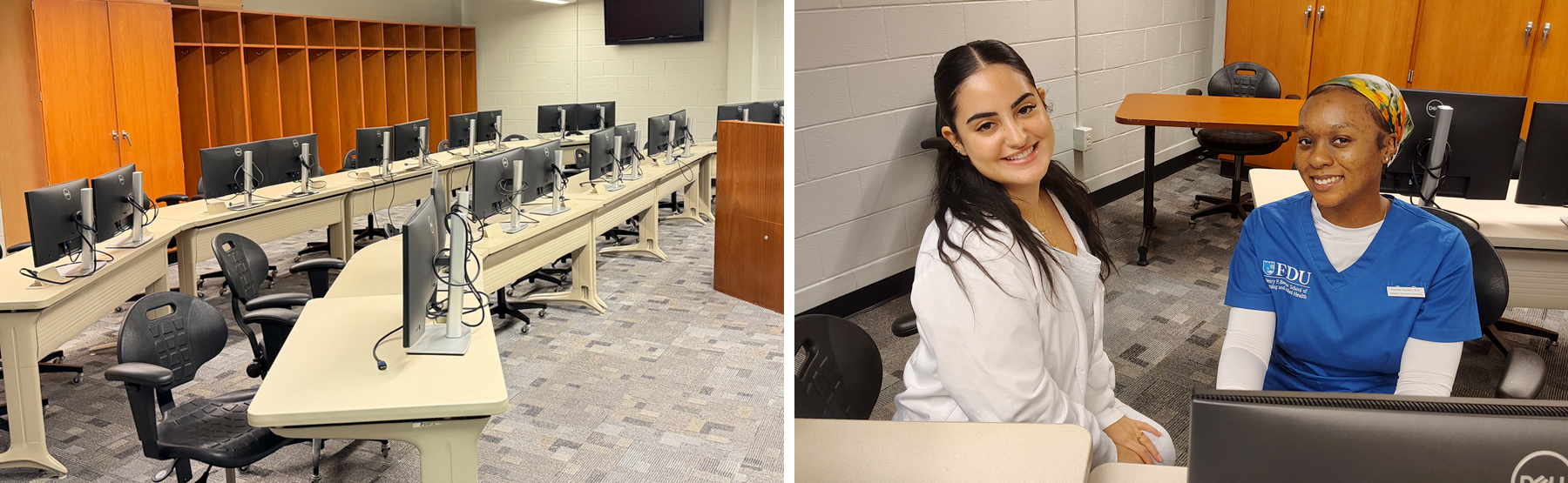
At the ChartSmart Lab, left, on the second floor of Dickinson Hall on the Metropolitan Campus are nursing students, from left, Nayanna Miranda and A’janea Dunson.
By practicing digital documentation, multi-team communication and virtual patient consultations in a safe educational setting, students bridge the gap between classroom theory and real-world clinical environments before graduation. Simulating these virtual consultations specifically teaches students how to overcome the unique communication barriers presented by remote healthcare.
The College of Nursing and Allied Health (CoNAH) is one of only eight nursing schools in the country that currently teaches Epic software to nursing students. “What makes our approach particularly distinctive is that we are the only nursing school integrating Epic throughout both pre-clinical and clinical coursework,” said Maria Moffa, nursing and director, experiential learning and digital health operations (Metro). “Rather than treating electronic health record education as a stand-alone training experience, we are embedding Epic directly into the nursing curriculum so that students learn to use the electronic health record as part of the way they learn and practice nursing.”
For instance, Epic training and documentation are incorporated into the skills laboratory experiences in preclinical courses such as Foundations for Nursing and Comprehensive Health Assessment. “As students learn fundamental nursing skills, conduct patient assessments and develop clinical reasoning, they also learn how to document those activities appropriately in the electronic health record,” Moffa added. “This helps students begin to understand that documentation is not separate from patient care — it is an essential component of communication, clinical decision-making, patient safety and continuity of care.”
By introducing students to electronic health records, telehealth and remote monitoring during their nursing education, CoNAH is preparing its graduates to practice confidently in an increasingly technology-enabled healthcare environment.