Mechanical Engineering BSME
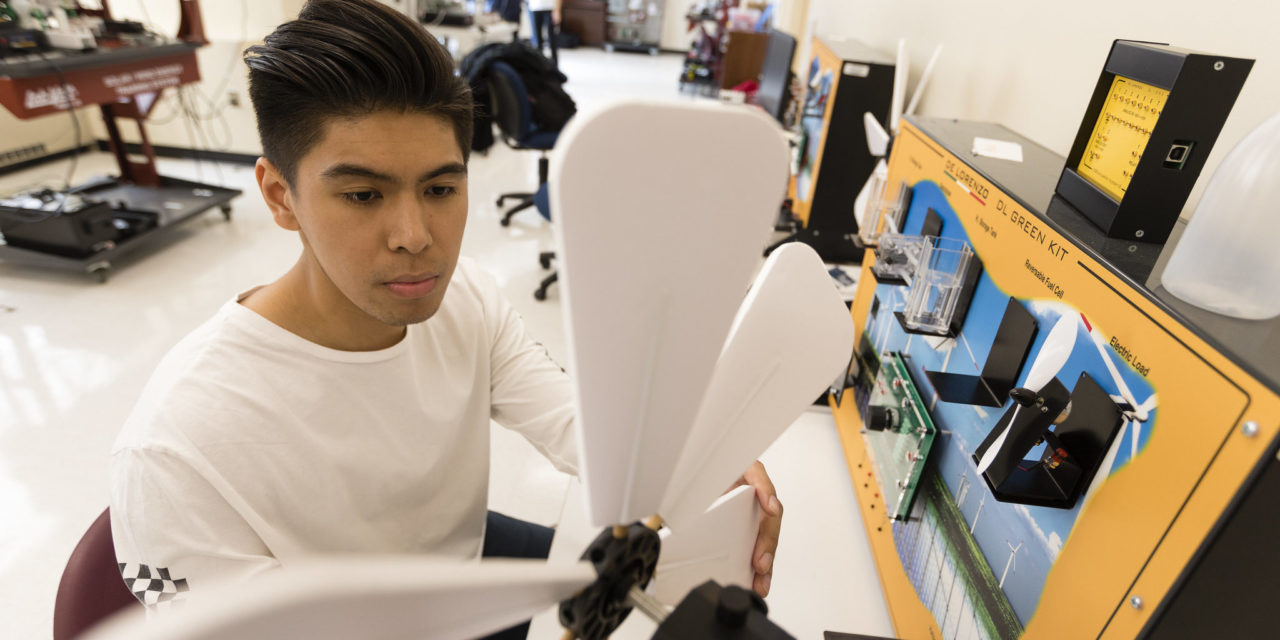
Mechanical engineering is one of the largest, broadest, and most diverse engineering disciplines. The Bachelor of Science in Mechanical Engineering (BSME) degree program prepares graduates for entrance into the profession of mechanical engineering or graduate study. The program graduates will work in industry as mechanical engineers, typically specializing as machine design engineers, manufacturing engineers, power engineers, electromechanical engineers, or automotive engineers.
The BSME curriculum provides students with a varied and balanced educational experience through an appropriate combination of theoretical concepts and practical applications. The program focuses on four key areas of mechanical engineering: mechanical design, electromechanical devices and controls, advanced manufacturing, and thermal sciences. Students will learn to analyze, design, build, test, operate, and maintain mechanical components, devices, systems, processes, and facilities; estimate costs; and manage projects.
Professional Accreditation
The Bachelor of Science in Mechanical Engineering program is accredited by the Engineering Accreditation Commission of ABET, https://www.abet.org, under the commission’s General Criteria and Program Criteria for Mechanical and Similarly Named Engineering Programs.
Educational Objectives
The educational objectives of the B.S. in Mechanical Engineering program define the career and professional accomplishments that the graduates are being prepared to achieve three to four years after graduation. The program will produce graduates who:
- Enter into and advance in the profession of mechanical engineering, particularly in the areas of mechanical design, electromechanical devices and controls, advanced manufacturing and thermal-fluid sciences.
- Continue their professional development by engaging in professional activities; taking industrial training courses; and pursuing engineering certifications and graduate degrees in engineering, science, or business.
- Become responsible professionals and global citizens who are aware of ethical issues and societal needs and problems.
These objectives are consistent with the mission of Fairleigh Dickinson University to educate and prepare students as world citizens through global education. They also fulfill the needs of the program constituencies, which include students, alumni, employers, faculty and the Industrial Advisory Board.
Student Outcomes
The B.S. in Mechanical Engineering program has adopted the student outcomes of the Engineering Accreditation Commission (EAC) of ABET as its own student outcomes, which define the attributes, skills and knowledge that the graduates are expected to possess upon or before graduation. Each mechanical engineering graduate will demonstrate the following attributes and achievements as required by the EAC of ABET upon or before graduation:
- An ability to identify, formulate and solve complex engineering problems by applying principles of engineering, science and mathematics.
- An ability to apply engineering design to produce solutions that meet specified needs with consideration of public health, safety, and welfare, as well as global, cultural, social, environmental, and economic factors.
- An ability to communicate effectively with a range of audiences.
- An ability to recognize ethical and professional responsibilities in engineering situations and make informed judgments, which must consider the impact of engineering solutions in global, economic, environmental and societal contexts.
- An ability to function effectively on a team whose members together provide leadership, create a collaborative and inclusive environment, establish goals, plan tasks, and meet objectives.
- An ability to develop and conduct appropriate experimentation, analyze and interpret data, and use engineering judgment to draw conclusions.
- An ability to acquire and apply new knowledge as needed, using appropriate learning strategies.
Cooperative Education Option
Students in the B.S.M.E. program have the option to undertake a cooperative education experience and earn a total of 6 academic credits toward their technical electives. Note that these credits may not be substituted for any required course work. The co-op experience provides students a real-world grounding, linking theory and practice, academic and industrial experiences, and college education and lifelong learning. It better prepares students for jobs, gives them a competitive edge in the job market, helps them develop networking skills and professional contacts and allows them to experience career fields before graduation. Industry benefits from better-prepared graduates with real and relevant work experience – saving time and money by reducing the training period for new employees.
Degree Plan
The program requires the successful completion of 121 credits with a minimum cumulative grade point ratio of 2.00. The credit distribution is as follows:
Semester 1 (15 credits)
- ENGR1301 Engineering Practices, Graphics and Design (3 credits)
- MATH1201 Calculus I (4 credits)
- PHYS2201 Physics Laboratory I (1 credit)
- PHYS2203 University Physics I Lecture (3 credits)
- UNIV1001 Transitioning to University Life (1 credit)
- WRIT1002 Composition I: Rhetoric and Inquiry (3 credits)
Semester 2 (15 credits)
- ENGR1204 Programming Languages in Engineering (3 credits)
- MATH2202 Calculus II (4 credits)
- PHYS2202 Physics Laboratory II (1 credit)
- PHYS2204 University Physics II Lecture (3 credits)
- UNIV1002 Preparing for Professional Life (1 credit)
- WRIT1003 Composition II: Research and Argument (3 credits)
Semester 3 (16 credits)
- CHEM1201 General Chemistry I Lecture (3 credits)
- CHEM1203 General Chemistry I Laboratory (1 credit)
- ENGR2221 Statics (3 credits)
- MATH2210 Differential Equations (3 credits)
- MENG2232 Mechanical Measurement and Devices (3 credits)
- ENGR2210 Technical Communications (3 credits)
Semester 4 (15 credits)
- ENGR2228 Strength of Materials (3 credits)
- ENGR3351 Applied Thermodynamics (3 credits)
- ENGR3431 Dynamics (3 credits)
- MENG2235 Manufacturing Processes (3 credits)
- MENG3230 Computer Aided Design and Manufacturing (3 credits)
Semester 5 (15 credits)
- EENG2221 Signals and Systems I (3 credits)
- ENGR4254 Fluid Mechanics (3 credits)
- MATH2203 Calculus III (3 credits)
- MENG3155 Heat Transfer (3 credits)
- ENGR3211 Engineering Materials I (3 credits)
Semester 6 (15 credits)
- ENGR3000 Modern Technologies: Principles, Applications and Impacts (3 credits)
- ENGR4210 Managerial and Engineering Economic Analysis (3 credits)
- ENGR4221 Engineering Statistics and Reliability (3 credits)
- UNIV2001 Cross Cultural Perspectives (3 credits)
- MENG4360 Industrial Automation (3 credits)
Semester 7 (16 credits)
- MENG4248 Mechanical Engineering Design I (3 credits)
- MENG4355 Analog and Digital Control (3 credits)
- MENG4375 Electrical Energy Conversion (3 credits)
- MENG4384 Preparation for Senior Design Project (1 credit)
- Technical Elective (3 credits)
- MATH3220 Linear Algebra (3 credits)
Semester 8 (14 credits)
- MENG4356 Stress and Vibration Analysis (3 credits)
- MENG4386 Senior Design Project (2 credits)
- Technical Electives (6 credits)
- UNIV2002 Global Issues (3 credits)
Technical Electives: The student must take 9 credits of technical electives, to be chosen from the following:
- CENG3261 Estimating I (3 credits)
- CENG4260 Contracts and Specifications (3 credits)
- EENG2222 Signals and Systems II (3 credits)
- EENG3265 Electronics I (3 credits)
- ENGR2286 Digital System Design (3 credits)
- ENGR4001, ENGR4002 FE/EIT Exam Preparation I (2 credits) and II (1 credit)
- ENGR4263 Project Management in Engineering and Technology (3 credits)
- MENG3288 Microcontroller System Design (3 credits)
- MENG4040 Heating, Ventilation and Air Conditioning (HVAC) (3 credits)
- MENG4250 Mechanical Engineering Design II (3 credits)
- MENG4320 Advanced Computer Aided Design (3 credits)
- MENG4365 Advanced Fluid Mechanics (3 credits)
- MENG3160 Thermal Systems Analysis and Design (3 credits)
Other technical electives may be taken with prior approval from the GHSE Director or their designee. In addition, students may undertake a cooperative education experience and earn a total of 6 academic credits toward their technical electives.
Concentration Requirements, 15 credits
Students can complete one of the following concentration areas: Engineering Design, Engineering Management, or Mechatronics.
Engineering Design Concentration (15 credits)
A B.S. in Mechanical Engineering (BSME) major completing a concentration in engineering design will be able to effectively use CAD/CAM tools to design electro-mechanical systems.
Required Courses (12 credits):
- MENG3230 Computer Aided Design and Manufacturing (3 credits)
- MENG4248 Mechanical Engineering Design I (3 credits)
- MENG4250 Mechanical Engineering Design II (3 credits)
- ENGR2286 Digital System Design (3 credits)
Elective Courses (3 credits)
Take one course from the following list-
- MENG3288 Microcontroller System Design (3 credits)
- MENG4320 Advanced Computer Aided Design (3 credits)
The BSME students should check with their academic advisor regarding technical electives for the BSME degree program. Three design concentration courses will meet their 9-credit Technical Electives requirement.
To take any course in this BSME concentration, a student must meet all the requisites for that course.
Engineering Management Concentration (15 credits)
A B.S. in Mechanical Engineering (BSME) major completing a concentration in engineering management will be able to manage mechanical design and development projects.
Required Courses (9 credits)
- ENGR2210 Technical Communications (3 credits)
- ENGR4210 Managerial and Engineering Economic Analysis (3 credits)
- ENGR4263 Project Management for Engineering & Technology (3 credits)
Elective Courses (6 credits)
Take two courses from the following list-
- CENG3261 Estimating 1 (3 credits)
- MENG4040 Heating, Ventilation, Air Conditioning (3 credits)
- CENG4260 Contracts and Specifications (3 credits)
The BSME students should check with their academic advisor regarding technical electives for the BSME degree program. Three engineering management concentration courses will meet their 9-credit Technical Electives requirement.
To take any course in this BSME concentration, a student must meet all the requisites for that course.
Mechatronics Concentration (15 credits)
A B.S. in Mechanical Engineering (BSME) major completing a concentration in mechatronics will be able to design, develop, and maintain intelligent, automated electromechanical systems by combining key knowledge areas in mechanical and electrical engineering. These students may design industrial robots, automated production lines, and vehicle control systems in manufacturing environments. The list of courses are as follows:
Required Courses:
- EENG2221 Signals & Systems I (3 credits)
- EENG3265 Electronics I (3 credits)
- MENG3288 Microcontroller System Design (3 credits)
- MENG4355 Analog & Digital Control (3 credits)
- MENG4360 Industrial Automation (3 credits)
The students should check with their academic advisor regarding technical electives for the BSME degree program. One prerequisite (ENGR2286) and two required courses (EENG3265 and MENG3288) required for the mechatronics concentration will additionally satisfy their 9-credit Technical Electives requirement.
To take any course in this BSME concentration, a student must meet all the requisites for that course.
BSME graduates with a concentration in mechatronics, in addition to meeting EAC-ABET student outcomes, will be able to model, analyze, and design systems or processes that integrate hardware and software to control mechanical systems.
Electrical Engineering Minor
(For Mechanical Engineering Majors)
The Gildart Haase School of Engineering (GHSE) offers a 15-credit minor in electrical engineering (EE) for non-EE majors. This minor provides these students with a foundation in EE, and it can bring them additional employment opportunities and career options. The minor is appropriate to those non-EE majors who have strong mathematics and science backgrounds. To take any course in the minor, a student must meet all the prerequisites for that course. The required courses are as follows:
- EENG2221 Signals and Systems I (3 credits)
Additionally, take 4 courses (12 credits) from the following list:
Program Enrollment and Degree Data
The official fall term enrollments of the B.S. in Mechanical Engineering program for the last five academic years and the number of degrees conferred during each of those years
|
Academic Year |
Enrollment Year |
Degrees Awarded |
||||||
|
1st |
2nd |
3rd |
4th |
TOTAL |
|
|||
|
1 |
2026-2025 |
FT |
34 |
13 |
15 |
12 |
74 |
12 |
|
PT |
|
|
1 |
2 |
3 |
|||
|
2 |
2025-2024 |
FT |
31 |
13 |
16 |
17 |
77 |
15 |
|
PT |
|
1 |
1 |
|
2 |
|||
|
3 |
2024-2023 |
FT |
19 |
21 |
13 |
10 |
63 |
9 |
|
PT |
2 |
1 |
|
1 |
4 |
|||
|
4 |
2023-2022 |
FT |
29 |
9 |
12 |
11 |
61 |
12 |
|
PT |
1 |
|
1 |
|
2 |
|||
|
5 |
2022-2021 |
FT |
26 |
10 |
9 |
12 |
57 |
12 |
|
PT |
1 |
|
|
2 |
3 |
|||
FT- full time; PT- part time