Acrobat PDF Accessibility

Table of Contents

Remediate a PDF in Adobe Acrobat Pro

First, open your PDF and run the Accessibility Checker.

This will run what is called an “automated” accessibility check. It is a fantastic way to catch a lot of accessibility issues, but it doesn’t find or correct all issues.

    1. Select “Tools” in the upper left-hand toolbar.
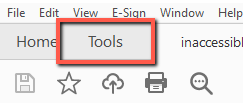
      Screenshot of the Adobe Acrobat menu bar with the "Tools" tab outlined in a red rectangle. Other visible menu items include File, Edit, View, E-Sign, Window, and Help, along with the Home tab and a toolbar with icons for save, bookmark, upload, print, and search.
    2. Under the “Protect & Standardize” bar, select “Add” under the accessibility tool.
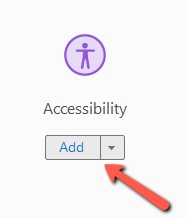
      Screenshot of the Adobe Acrobat Tools panel showing the "Accessibility" tool with its purple accessibility icon. A red arrow points to the "Add" button below it, indicating how to add the Accessibility tool to the toolbar.
    3. This will add your accessibility tools to your toolkit on the right-hand side of your screen.
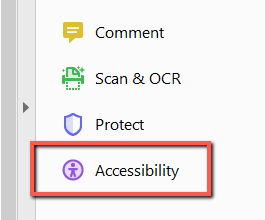
      Screenshot of the Adobe Acrobat right-hand Tools panel showing four tool options: Comment, Scan & OCR, Protect, and Accessibility. The "Accessibility" option is outlined in a red rectangle, with its purple accessibility icon visible.
    4. Now, select “Accessibility Check” within the accessibility toolkit.
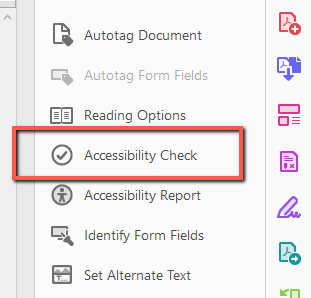
      Screenshot of the Adobe Acrobat Accessibility tools panel showing a list of options: Autotag Document, Autotag Form Fields (grayed out), Reading Options, Accessibility Check, Accessibility Report, Identify Form Fields, and Set Alternate Text. The "Accessibility Check" option is outlined in a red rectangle.
    5. The Accessibility Checker Options panel will appear. Select “Start Checking”.
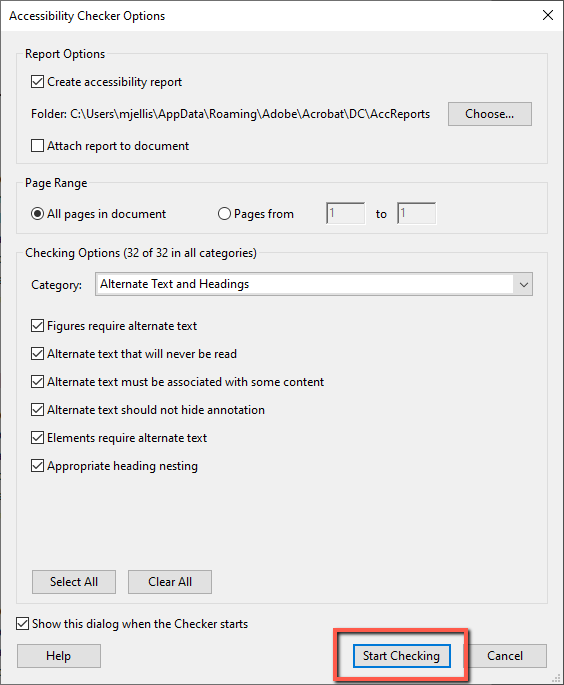
      Screenshot of the Adobe Acrobat "Accessibility Checker Options" dialog box. The Report Options section shows "Create accessibility report" checked with a folder path specified. The Page Range is set to "All pages in document." The Checking Options section shows 32 of 32 categories selected, with the "Alternate Text and Headings" category displayed, listing six checkboxes all checked: Figures require alternate text, Alternate text that will never be read, Alternate text must be associated with some content, Alternate text should not hide annotation, Elements require alternate text, and Appropriate heading nesting. The "Start Checking" button in the bottom right is outlined in a red rectangle.
      This tool will scan your document and report any accessibility errors it finds.
    6. Any accessibility errors found will appear in a panel on the left-hand side of the screen. At this point, you can further investigate what you need to do to correct these errors.
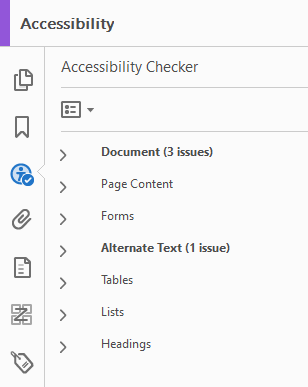
      Screenshot of the Adobe Acrobat Accessibility Checker results panel. The panel displays a collapsed tree list of categories, with "Document (3 issues)" and "Alternate Text (1 issue)" shown in bold to indicate detected problems. Other categories listed with no issues include Page Content, Forms, Tables, Lists, and Headings.

In this example, there are three Document accessibility issues and one Alternative Text accessibility issue found. We can learn more about what needs to be corrected by expanding these options within our Accessibility Checker.

Open the “Reading Order” tool in your accessibility toolkit.

The Reading Order tool is the key to excellent PDF remediation. This will help you add the invisible “tags” needed on your PDF to ensure screen readers can understand the content correctly.

What are “tags”?

Tags are digital labels used to organize content in a PDF. These labels give information to assistive technologies that allow the documents to be used (or used more effectively). Tags are added to several distinct parts of a document and build out of the structure of the information. These digital labels are added to paragraphs, tables, figures, and headings, to name a few.

Why are tags important?

Tags are the only reason PDF documents have internal structure. This structure is the only way that assistive technology users can access the information in a PDF document. Adding tags – and ensuring those tags are correct and in a logical order – will ensure that your document is available to everyone, regardless of how the information is accessed.

To open the Reading Order tool, select “Reading Order” in the list of tools available in your accessibility tab. This is found on the right-hand side of your screen.
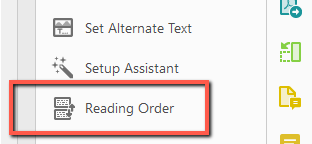
Screenshot of the Adobe Acrobat Accessibility tools panel showing three options: Set Alternate Text, Setup Assistant, and Reading Order. The "Reading Order" option is outlined in a red rectangle.

This will open the Reading Order pane, shown below.
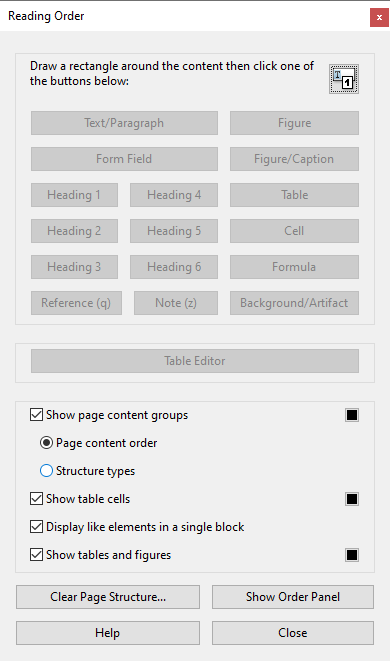
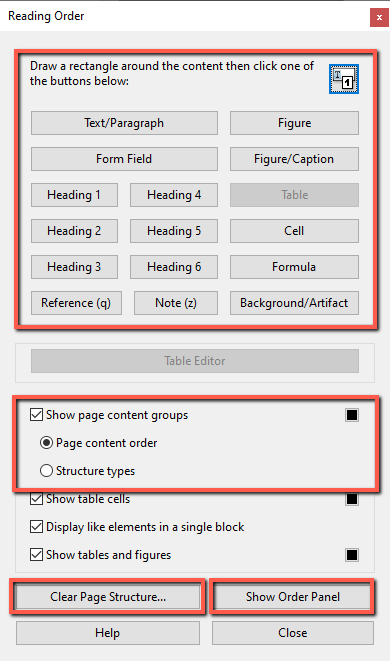
Screenshot of the Adobe Acrobat "Reading Order" dialog box. The top section contains content-type buttons for tagging selected content, including Text/Paragraph, Figure, Form Field, Figure/Caption, Heading 1 through Heading 6, Table, Cell, Formula, Reference, Note, and Background/Artifact, as well as a Table Editor button. The bottom section shows display options with "Show page content groups" checked and "Page content order" selected, along with "Show table cells," "Display like elements in a single block," and "Show tables and figures" all checked. "Clear Page Structure" and "Show Order Panel" buttons are visible at the bottom.

Screenshot of the Adobe Acrobat "Reading Order" dialog box with three sections outlined in red rectangles. The top section highlights the content-type tagging buttons, including Text/Paragraph, Figure, Form Field, Figure/Caption, Heading 1 through Heading 6, Table, Cell, Formula, Reference, Note, and Background/Artifact. The middle section highlights the display options, showing "Show page content groups" checked and "Page content order" selected. The bottom section highlights the "Clear Page Structure" and "Show Order Panel" buttons.

What is a Reading Order Pane?

The top tools are used to tag or re-tag a feature. For example, if you need to designate something as a figure when tagged as a paragraph, you can correct that using these tools.

You can have one of two page content groups displayed at once, and you can toggle between them. Page Content Order will display the reading order of your tagged document, while the Structure Type will display what tags have been used for different artifacts.

The Show Order Panel button will open up the Order Panel toolkit. In this tool area, you can correct the reading order of your document. Sometimes a PDF has been tagged automatically or needs to be re-tagged from scratch. If it is easier to correct tags from scratch, you can select Clear Page Structure to remove all tags on the page you are currently viewing.

Document

Logical Reading Order – Needs manual check

Every time you run the Accessibility Checker, your document will get flagged for Logical Reading Order. This is because Adobe has no way of knowing if your document is in a logical reading order– you have to check for yourself! Thankfully, it is easy to do.

  1. Open your “Reading Order” Tool.
    Screenshot of the Adobe Acrobat Accessibility tools panel showing three options: Set Alternate Text, Setup Assistant, and Reading Order. The "Reading Order" option is outlined in a red rectangle.
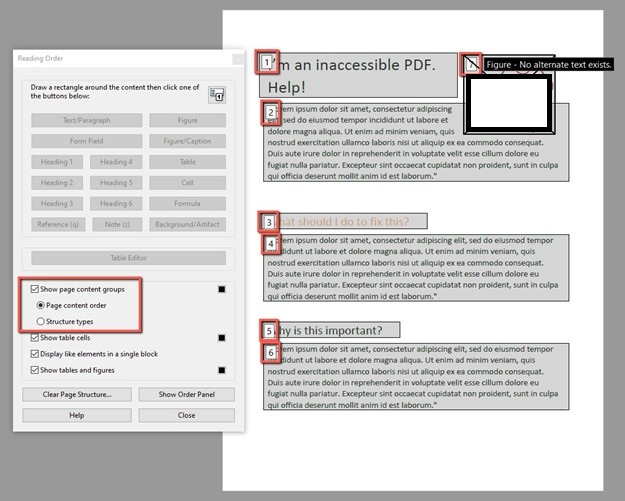
  2. Select “Page content order” under “Show page content group”. This will toggle your interface to display the reading order of your page.
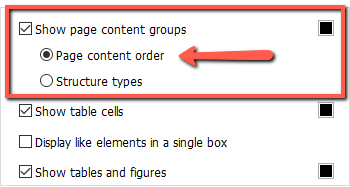
    Screenshot of a portion of the Adobe Acrobat "Reading Order" dialog box showing display options, outlined in a red rectangle. A red arrow points to the "Page content order" radio button, which is selected. Other visible options include "Show page content groups" (checked), "Structure types" (unselected), "Show table cells" (checked), "Display like elements in a single box" (unchecked), and "Show tables and figures" (checked).
  3. The figure labeled with a 1 will be the first item read with a screen reader. The second item read will have a 2 label. This will continue for the duration of the page you are viewing.Screenshot of Adobe Acrobat showing the "Reading Order" dialog on the left and a PDF document on the right in page content order view. The PDF displays numbered content blocks: block 1 is the heading "I'm an inaccessible PDF. Help!," block 2 is the first body text paragraph, block 3 is the heading "What should I do to fix this?," block 4 is the second body text paragraph, block 5 is the heading "Why is this important?," and block 6 is the third body text paragraph. A black image in the top right is flagged with "Figure – No alternate text exists." The "Page content order" radio button is highlighted in a red rectangle in the dialog.
    Note: Each document page will have its own reading order. Each page will need this manual check.

Primary Language – Failed

By adding a language attribute to your document, you are ensuring that screen readers have all the information needed to understand that document correctly. Adding a default language is also extremely easy to do in Adobe.

  1. Select the “Primary Language – Failed” notification in your Accessibility Checker pane.
  2. Select “Fix” in the menu that appears.
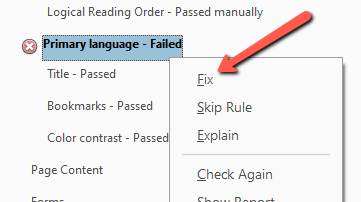
    Screenshot of the Adobe Acrobat Accessibility Checker results panel showing "Primary language – Failed" selected with a red error icon, and a right-click context menu open. A red arrow points to the "Fix" option at the top of the menu. Other menu options include Skip Rule, Explain, Check Again, and Show Report. Other visible items in the results panel include Logical Reading Order (passed manually), Title (passed), Bookmarks (passed), Color contrast (passed), and Page Content.
  3. The “Set Reading Language” pane will appear. Use the drop-down menu to select your document’s language. This drop-down menu will most likely default to English.
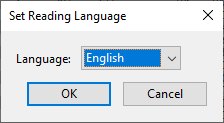
    Screenshot of the Adobe Acrobat "Set Reading Language" dialog box with the Language dropdown set to "English," highlighted in blue. The dialog contains "OK" and "Cancel" buttons at the bottom.
  4. Select “OK” to save your choice

Title – Failed

Titles are used to label your document and are very important for screen reader users to know what files they are opening.

Note: This information is different from the name you have used for the saved file.

  1. Right-click the “Title – Failed” notification in your Accessibility Checker pane.
  2. Select “Fix” in the menu that appears.
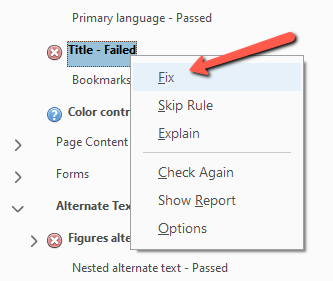
    Screenshot of the Adobe Acrobat Accessibility Checker results panel showing "Title – Failed" selected with a red error icon, and a right-click context menu open. A red arrow points to the "Fix" option at the top of the menu. Other menu options include Skip Rule, Explain, Check Again, Show Report, and Options. Other visible items in the results panel include Primary language (passed), Bookmarks, Color contrast, Page Content, Forms, and Alternate Text with "Figures alternate text" expanded showing "Nested alternate text – Passed."
  3. The “Description” pane will appear. Un-select the “Leave as it” checkbox, add your Title, and select “OK”.
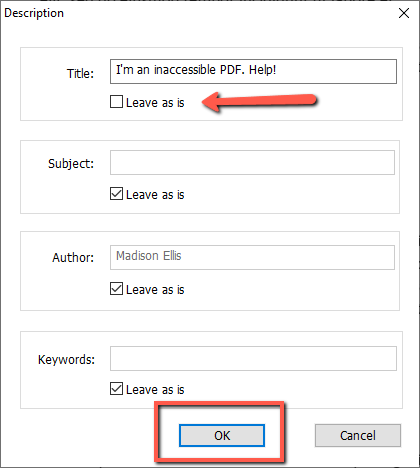
    Screenshot of the Adobe Acrobat "Description" dialog box for setting PDF document properties. The Title field contains "I'm an inaccessible PDF. Help!" with the "Leave as is" checkbox unchecked, indicated by a red arrow. The Subject and Keywords fields are empty with "Leave as is" checked, and the Author field shows "Madison Ellis" with "Leave as is" checked. The "OK" button in the bottom right is outlined in a red rectangle.

Color Contrast – Needs Manual Check

Every time you run the Accessibility Checker, your document will get flagged for Color Contrast. This is because Adobe has no way of knowing if your document has acceptable color contrast – you have to check for yourself! Thankfully, it is easy to do.

What is color contrast?

Color contrast refers to ensuring that the color of the text of a document has enough contrast with the background color for visual readers to easily read it. This helps users who have variations of color blindness, have low vision, or just need more contrast to read your content. Dark text on a light-colored background is almost always an excellent choice.

Great text color contrast combinations

  • Black and White
  • Purple and Yellow
  • Navy and Light Grey

Bad text color contrast combinations

  • Orange and White
  • Green and White
  • Red and Green

How do I check color contrast?

Since Adobe doesn’t have the capability of checking a document’s color contrast on its own, it is your responsibility to ensure that all your text can be easily read. If there is any text you feel might be an issue, there are online tools that can help ensure you have enough contrast.

WebAIM Color Contrast Checker

Adobe Color Contrast Checker

Help! My text doesn’t have enough contrast! What should I do?

The Adobe PDF editor has built-in tools that allow you to change the color of the text in your document very quickly. This can help remediate many color contrast accessibility concerns. Unfortunately, this tool only allows you to change the color of recognized text.

Remember: Black text on a white background has the highest color contrast ratio.

  1. Select the “Edit PDF” tool. This can be found in the right tools panel, or under “Tools” in your top toolkit.
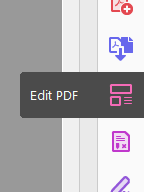
    Screenshot of the Adobe Acrobat right-hand tools panel with a tooltip displaying "Edit PDF" next to its pink toolbar icon.
  2. Highlight the text that you want to change the color of. This should auto-populate the current text color in the editing toolkit.
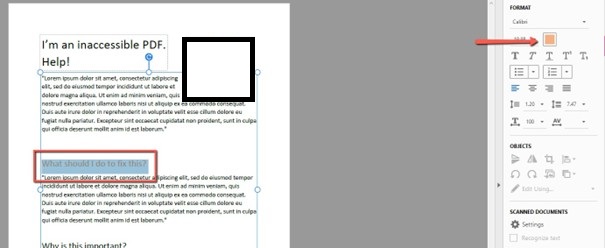
    Screenshot of Adobe Acrobat in Edit PDF mode, showing a PDF document with the heading "What should I do to fix this?" selected and outlined in a blue text box. The Format panel on the right displays text formatting options including font (Calibri) and a color swatch, with a red arrow pointing to the font color picker. Other visible sections in the right panel include Objects and Scanned Documents.
  3. Select the color pallet. This will open a color pallet for you to choose a new color.
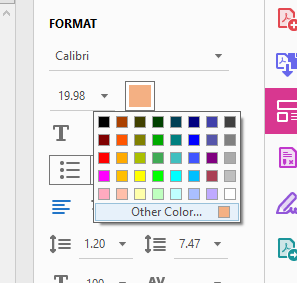
    Screenshot of the Adobe Acrobat Edit PDF Format panel with a color picker open, showing a grid of color swatches and an "Other Color…" option at the bottom. The font is set to Calibri at size 19.98, with the current color swatch showing a light peach/tan color.
  4. Select your new color – ensuring that this color meets color contrast standards. This will automatically change the color of the text you have highlighted. You can always double-check using the color contrast checkers at WebAIM or Adobe. In this example, we changed the color of our text from light orange to black. We can be confident that this meets color contrast standards because we know that black text on a white background has the highest color contrast ratio available.

Alternative Text

Alternative text (sometimes called ‘alt-text’) is a text description of an image and is incredibly important for accessibility. Can you imagine trying to understand a document full of images and having no idea what the images are showing you? This is where alternative text comes to the rescue.

Figures Alternate Text – Failed

  1. Select the drop-down menu under “Figures alternative text – Failed”. This will show you all the figures in your document that do not have alternative text associated with it. This does not mean all the figures in your document have correct or helpful alternative text.
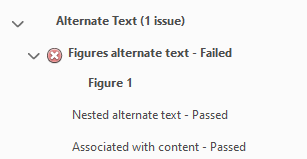
    Accessibility checker results panel showing alternate text validation status. The panel displays 'Alternate Text' with one issue noted. 'Figures alternate text' shows a failed status with a red X icon, with 'Figure 1' listed below it. Two additional checks are shown: 'Nested alternate text' and 'Associated with content', both marked as passed.
  2. Select the figure that doesn’t yet have alt text. This will highlight the image associated with the error, so you know what you are working with.
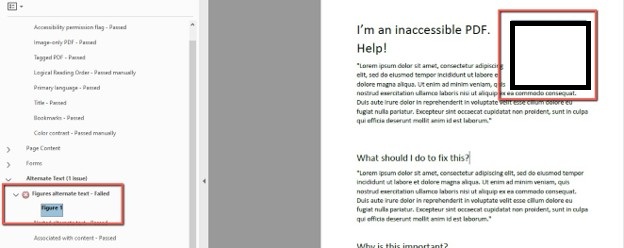
    Accessibility checker interface in Adobe Acrobat showing a split view. Left panel displays accessibility validation results with various checks including "Alternate Text (1 issue)" with a failed status highlighted in a red box. Right panel shows a PDF document titled "I'm an inaccessible PDF. Help!" containing Lorem Ipsum placeholder text and a black square image with a red border in the upper right corner. The document demonstrates common PDF accessibility issues and includes sections asking "What should I do to fix this?" and "Why is this important?"
  3. Right-click the figure error and select “Fix”.
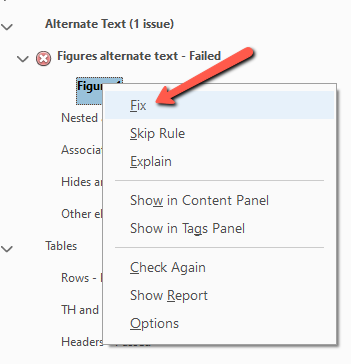
    Context menu in Adobe Acrobat's accessibility checker panel with a red arrow pointing to the "Fix" option. The menu appears next to a failed "Figures alternate text" check and includes options such as Skip Rule, Explain, Show in Content Panel, Show in Tags Panel, Check Again, Show Report, and Options.
  4. The Set Alternative Text pane will open. Add your alternative text and select “Save and Close”.
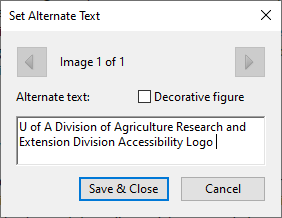
    Set Alternate Text dialog box in Adobe Acrobat showing navigation controls for Image 1 of 1, an unchecked Decorative figure checkbox, and a text field containing "U of A Division of Agriculture Research and Extension Division Accessibility Logo" with Save & Close and Cancel buttons at the bottom.

What is a “Decorative Figure”?

Decorative Figures are any image that is not directly related to the content being discussed. If an image is just used to fill white space or doesn’t contribute to a better understanding of what is being discussed, it can be considered “decorative” and does not need alternative text.

Tables 

Headers – Failed

Header levels are incredibly important to include in tables. This allows screen reader users to navigate the table and fully understand its message.

  1. Under “Headers – Failed”, select the Element with an accessibility error. This action will highlight the table in your document that needs a summary added to it.
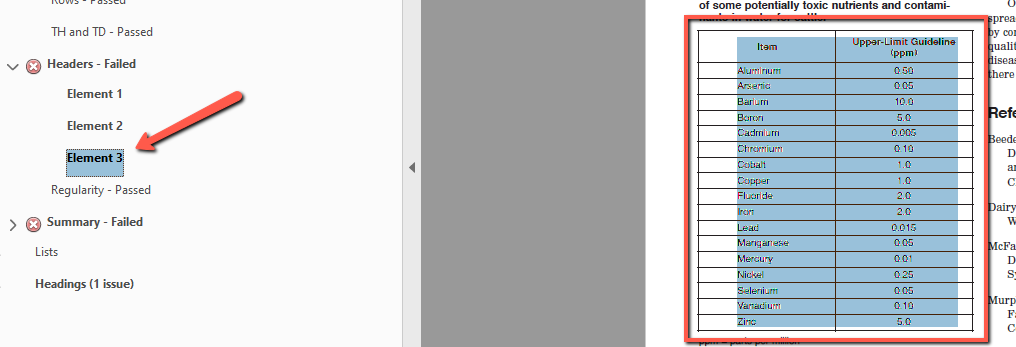
    Split screen view of Adobe Acrobat showing the accessibility checker on the left and a PDF document on the right. The checker panel displays a failed Headers check with Element 3 highlighted in blue and pointed to by a red arrow. The PDF document features a table outlined in red listing various chemical elements like Aluminum, Arsenic, and Barium in the first column and their corresponding Upper-Limit Guideline values in ppm in the second column.
  2. Now that you know what table is missing a header, select the “Reading Order” tool on the right-side of your screen. Your reading Order tool pane will appear.
    Screenshot of the Adobe Acrobat Accessibility tools panel showing three options: Set Alternate Text, Setup Assistant, and Reading Order. The "Reading Order" option is outlined in a red rectangle.
  3. Right-select the table you want to add header levels to and select “Table Editor”.
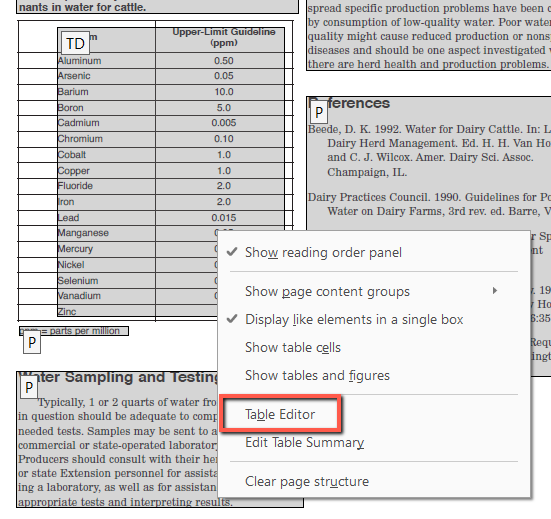
    Context menu in Adobe Acrobat showing table editing options with the "Table Editor" option highlighted in a red box. The menu appears over a PDF document containing a table listing nutrients and their upper-limit guidelines, with visible table structure tags. Menu options include Show reading order panel, Show page content groups, Display like elements in a single box, Show table cells, Show tables and figures, Table Editor, Edit Table Summary, and Clear page structure.
    This will show you how every cell in your table is labeled.
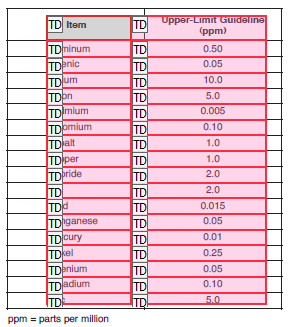
    Table showing nutrient upper-limit guidelines with three columns labeled TD, Item, and Upper-Limit Guideline (ppm). The table has a pink background and lists various chemical elements and nutrients including Aluminum (0.50), Arsenic (0.05), Barium (10.0), Boron (5.0), Cadmium (0.005), Chromium (0.10), Cobalt (1.0), Copper (1.0), Fluoride (2.0), Iodine (2.0), Lead (0.015), Manganese (0.05), Mercury (0.01), Nickel (0.25), Selenium (0.05), Vanadium (0.10), and Zinc (5.0). Each row shows TD tags indicating table data cells. A note at the bottom states "ppm = parts per million."
    Note: “TD” stands for “Table Date” while “TH” stands for “Table Header”.
  4. Select the cells you want to change from “Table Date (TD)” to “Table Header (TH)”. Right-click the highlighted cells and select “Table Cell Properties”.
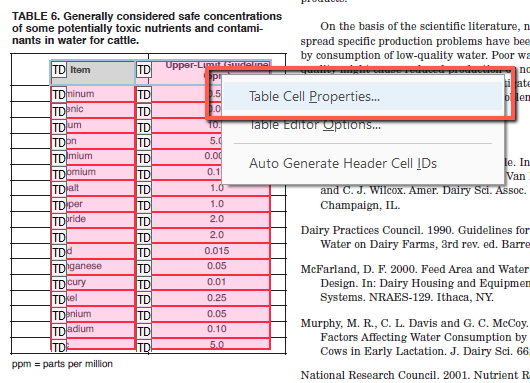
    Context menu in Adobe Acrobat Table Editor showing options for a table cell. The "Table Cell Properties..." option is highlighted in blue and outlined in a red box. Other visible menu options include "Table Editor Options..." and "Auto Generate Header Cell IDs". The menu is positioned over a table titled "TABLE 6. Generally considered safe concentrations of some potentially toxic nutrients and contaminants in water for cattle," which lists items like Aluminum and Arsenic with their upper-limit guidelines. The table cells are highlighted in pink and marked with "TD" tags.
  5. The “Table Cell Properties” pane will open. Select “Header Cell”. This will re-tag your selected cells as header data instead of table data. Select “OK”.
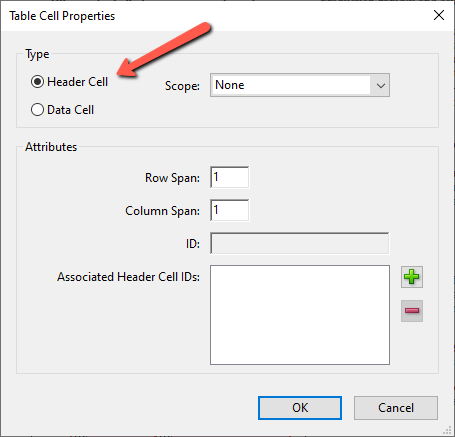
    Table Cell Properties dialog box in Adobe Acrobat with a red arrow pointing to the selected Header Cell radio button. The dialog shows Type options with Header Cell selected and Data Cell unselected, a Scope dropdown set to None, Row Span and Column Span fields both set to 1, an empty ID field, and an empty Associated Header Cell IDs text box with plus and minus buttons. OK and Cancel buttons appear at the bottom.

    The resulting table will have newly tagged Header cells
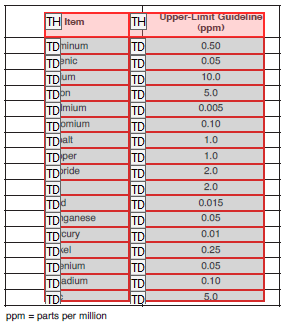
    Table showing upper-limit guidelines for various nutrients and elements with proper accessibility tags. The header row contains "Item" and "Upper-Limit Guideline (ppm)" columns marked with TH tags in pink. Data rows list Aluminum (0.50), Arsenic (0.05), Boron (10.0), Cadmium (0.005), Chromium (0.10), Copper (1.0), Fluoride (2.0), Iodine (2.0), Lead (0.015), Manganese (0.05), Mercury (0.01), Nickel (0.25), Selenium (0.05), Vanadium (0.10), and Zinc (5.0), all marked with TD tags. A note at the bottom indicates ppm equals parts per million.

Summary – Failed

Table summaries are typically two to three sentences that describe the overall understanding of your table. This helps screen reader users understand what the table is about before jumping into the data.

  1. Under “Summary – Failed”, select the Element with an accessibility error. This action will highlight the table in your document that needs a summary added to it.
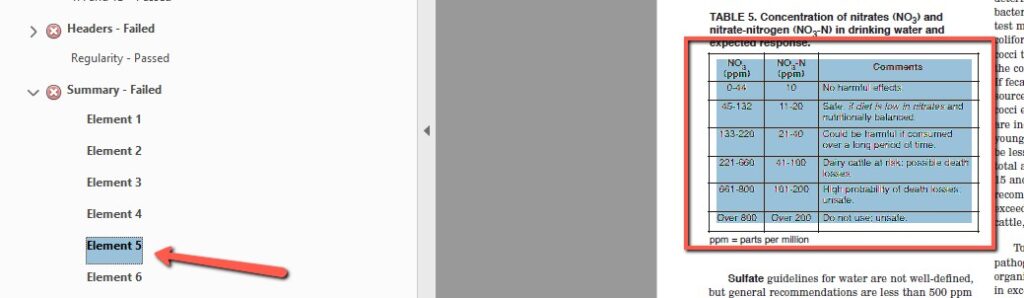
    Split screen view of Adobe Acrobat showing the accessibility checker panel on the left and a PDF document on the right. The checker displays a failed Summary with Element 5 highlighted in blue and indicated by a red arrow. The PDF shows TABLE 5 outlined in red, displaying concentration levels of nitrates (NO₃) and nitrate-nitrogen (NO₃-N) in drinking water with expected responses for cattle. The table contains three columns showing ppm ranges and corresponding health effect comments, with a note below stating "ppm = parts per million."
  2. Now that you know which table has the concern, select the “Reading Order” tool on the right-side of your screen. Your Reading Order tool pane will appear.
    Screenshot of the Adobe Acrobat Accessibility tools panel showing three options: Set Alternate Text, Setup Assistant, and Reading Order. The "Reading Order" option is outlined in a red rectangle.
  3. Right-select the table you want to add a summary to and select “Edit Table Summary”.
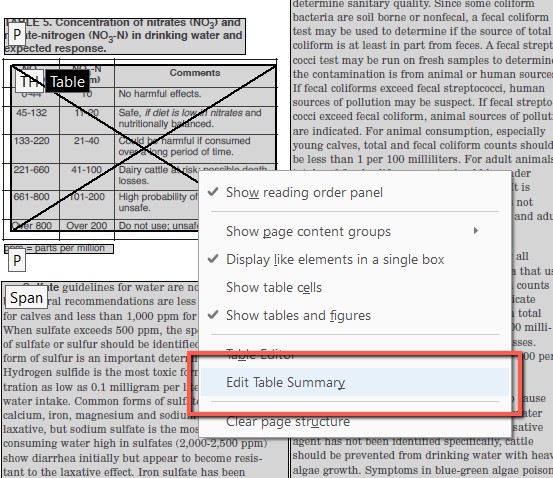
    Context menu in Adobe Acrobat showing table editing options with the Edit Table Summary option highlighted in blue and outlined in red. The menu appears over a PDF document containing a table about nitrate concentrations in drinking water. Visible menu options include Show reading order panel, Show page content groups, Display like elements in a single box, Show table cells, Show tables and figures, Table Editor, Edit Table Summary, and Clear page structure.
  4. The table summary pane will appear. Insert your table summary and select “OK”. Repeat for any other tables that need summary information.
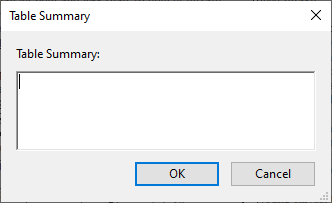
    Table Summary dialog box in Adobe Acrobat showing an empty text field with a cursor for entering table summary information. The dialog has an OK button highlighted in blue and a Cancel button at the bottom.

Headings

Headings are used by screen reader users to move through content, better understand the structure of a document, and find the information they need. By adding correct headings to your document, you will ensure a better experience to all users.

Appropriate Nesting – Failed

Headers must be added in descending order. For example, a Header Level 2 may not precede a Header Level 1. Sometimes header levels get mixed up and become “inappropriately nested”. This simply means that a header level tag has been mixed up and will need to be tagged differently.

  1. Under the “Appropriate nesting – Failed” tag, select the Element that has an error. This will highlight the header tag that needs more attention.
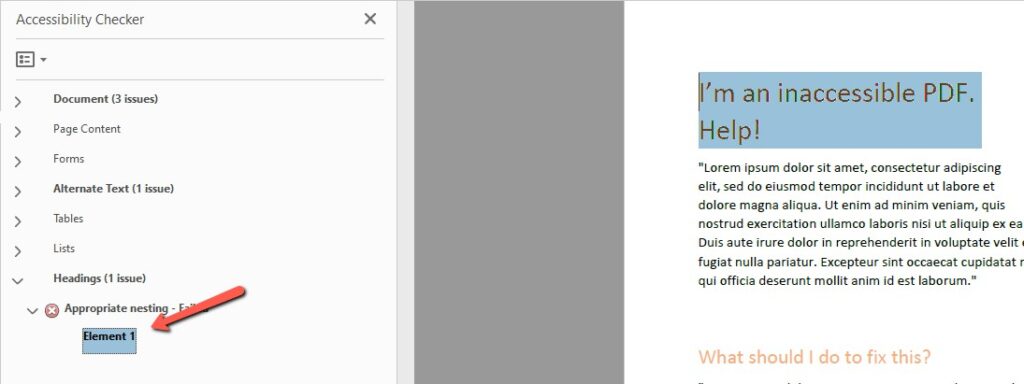
    Adobe Acrobat Accessibility Checker panel on the left showing a failed Appropriate nesting check under Headings with Element 1 highlighted in blue and indicated by a red arrow. The panel lists categories including Document with 3 issues, Page Content, Forms, Alternate Text with 1 issue, Tables, Lists, and Headings with 1 issue. The right side displays a PDF document with a blue highlighted heading reading "I'm an inaccessible PDF. Help!" followed by Lorem Ipsum placeholder text and an orange question asking "What should I do to fix this?"
  2. Open the “Reading Order” tool in your Accessibility toolkit. This will allow you to see what header level your header is tagged as.
    Screenshot of the Adobe Acrobat Accessibility tools panel showing three options: Set Alternate Text, Setup Assistant, and Reading Order. The "Reading Order" option is outlined in a red rectangle.

In this example, the header has a Header Level 2 tag when it needs a Header Level 1 tag.
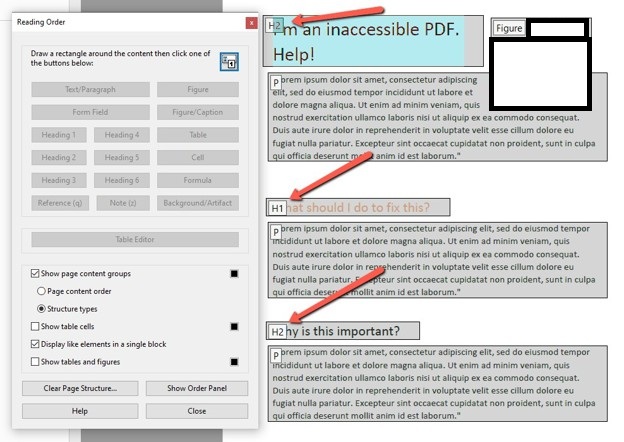
Adobe Acrobat Reading Order tool interface with a dialog box on the left showing tagging options like Text/Paragraph, Figure, and Headings. On the right, a PDF document displays structure tags overlaid on the content. Red arrows point to specific heading tags: an H2 tag on the title "I'm an inaccessible PDF. Help!", an H1 tag on the heading "What should I do to fix this?", and an H2 tag on "Why is this important?". Other visible tags include a Figure box and paragraph tags labeled "p".

  1. Select the content you want to change the tag label as. This will highlight the tagged content.
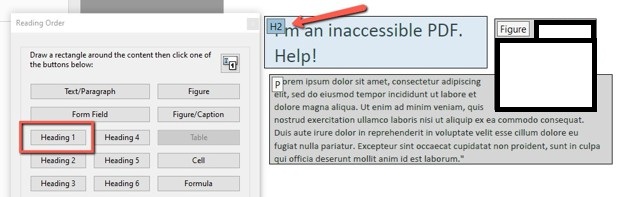
    Reading Order dialog box in Adobe Acrobat with the Heading 1 button highlighted in a red box. The panel displays various tagging options including Text/Paragraph, Figure, Form Field, Figure/Caption, and multiple heading levels. On the right, a PDF document shows an H2 tag on the title "I'm an inaccessible PDF. Help!" indicated by a red arrow, with a Figure box and paragraph tag visible on the content.
  2. In the open “Reading Order” pane, select the “Heading” you want re-tag this content with. This will immediately re-tag this content.
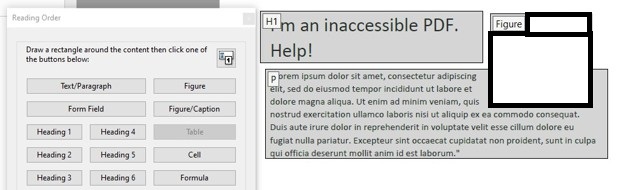
    Reading Order dialog box in Adobe Acrobat showing tagging options with the PDF document on the right displaying the title "I'm an inaccessible PDF. Help!" now properly tagged with an H1 heading tag indicated by a black outline box, demonstrating the corrected heading structure after changing from H2 to H1.
  3. Repeat as needed for any additional content.