State of the Art
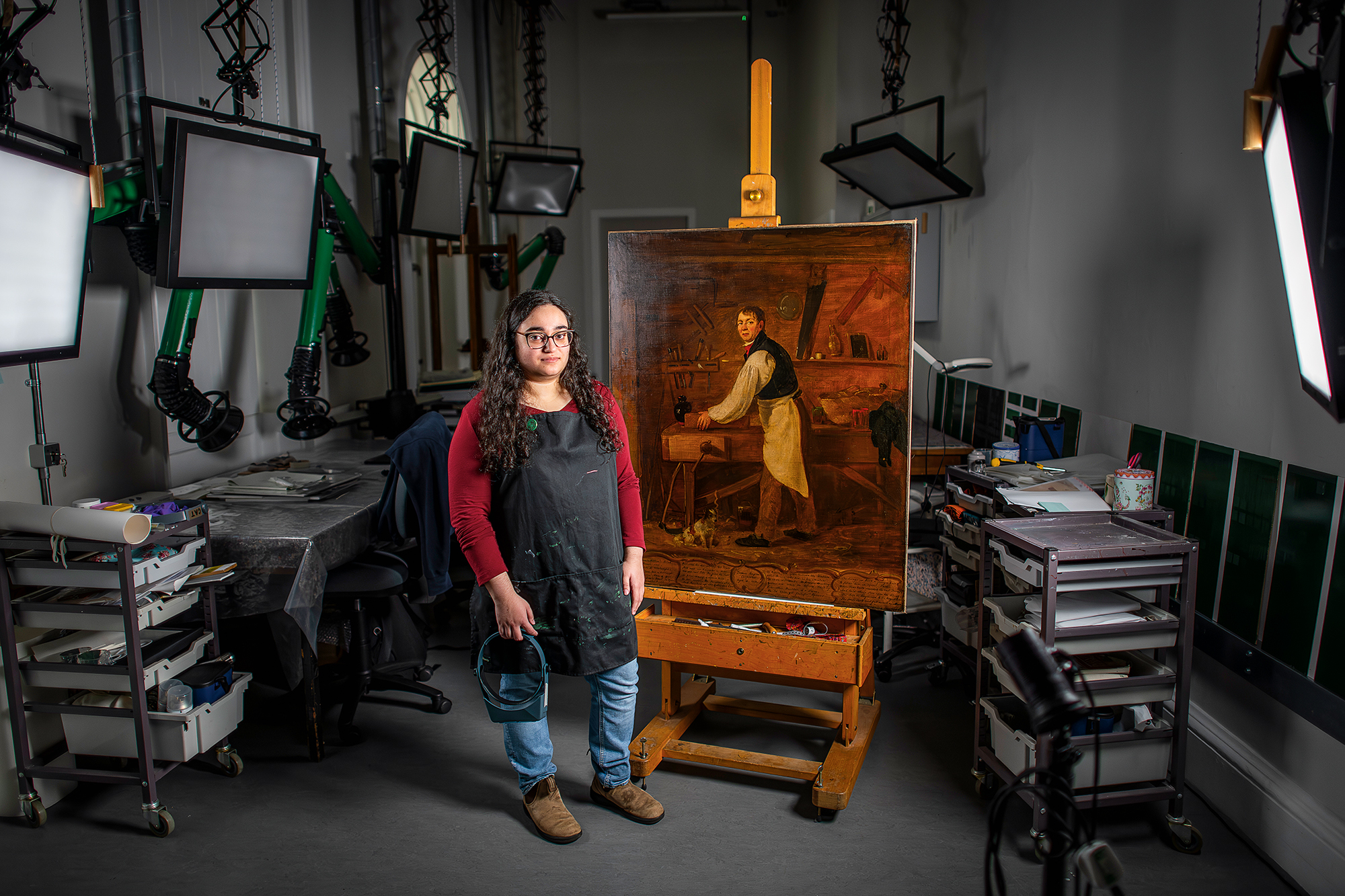
(Photo: Joshua Bright)
Nitzan Eliyahu, BS’22 (Metro)
By Kenna Caprio
In the studios and labs at The Courtauld Institute of Art in London, students studying art conservation carefully document, analyze and treat precious works of art, some centuries old.
Nitzan Eliyahu, BS’22 (Metro), spends her days here working toward a master’s degree in conservation of easel paintings.
“Art conservation is always working behind the scenes,” says Eliyahu. “At museums, bug traps, lighting, rope cordons and humidity controls preserve the art and keep it safe so it can be enjoyed now and in the future. Centuries-old paintings, over their lifetimes, have had dozens of hands clean them, repair tears or cracks, replace discolored varnish, retouch losses, all so we can see something beautiful.”
Conservation and restoration are closely related disciplines. Conservation deals with stabilization and preservation to prevent further deterioration, while restoration is about repair, with the goal of coming as close to the original art as possible.
“In practice, the work I do has elements of both.”
Though she was always interested in art, she majored in mathematics at FDU, thinking she’d be a teacher.
But when she fell down an art conservation video hole on YouTube, she added minors in chemistry and art history. “A knowledge of chemistry is important for designing treatments, tailoring solubility and understanding aging. An art history background provides cultural context and an understanding of historical materials and practices.”
The oldest painting she’s treated dates to 1749. It’s “part of a series of regimental portraits commissioned by the Duke of Cumberland to record soldiers under his command. It’s owned by the Royal Collection Trust.”
While each painting requires different treatment, there are some standard practices. Conservators often surface clean to remove dirt and dust and also remove any discolored varnish.
“Each problem must be weighed with the painting’s original materials and technique, the painting’s life and physical history and the historical context of the piece,” Eliyahu says.
Conservators photograph paintings from every angle and keep detailed records. They examine paintings in a variety of light and with technology, possibly under a microscope; or with ultraviolet light; infrared reflectography or X-radiography.
These exams reveal more about the materials the artist used. Finally comes treatment, which requires a deft and gentle touch.
“Attention to detail is key to everything in conservation,” she says. “A painting I worked on had water damage, resulting in severe flaking and crumbling. To save as much original material as possible, I went under the microscope and used a small brush to glue down the flaking paint.”
For her thesis, Eliyahu is researching a set of portraits depicting servants. These paintings belong to Erddig, a National Trust property in Wales.
“Art provides a window into the past, and the stories a society tells about itself,” says Eliyahu. “Art conservation helps to keep that alive, so that future generations can appreciate the work, too. It’s a way of communicating across time.”
A QUIET LIFE
“I’m not one for the hustle. I think it’ll be nice to have a quiet life; me in a flow state with my paintings during the day and coming home to my cat and a good book in the evening.”
PAINTED MEMORIES
“During my semester abroad at Wroxton College, I kept a watercolor journal of my travels. I love to flip through the paintings and remember how I felt when I made them.”
FAVORITE MUSEUM
The Isabella Stewart Gardner Museum in Boston, Mass. “It was the first museum that made me understand how evocative art history can be; not just sterile white walls but living and breathing art.”