A Place at the Table
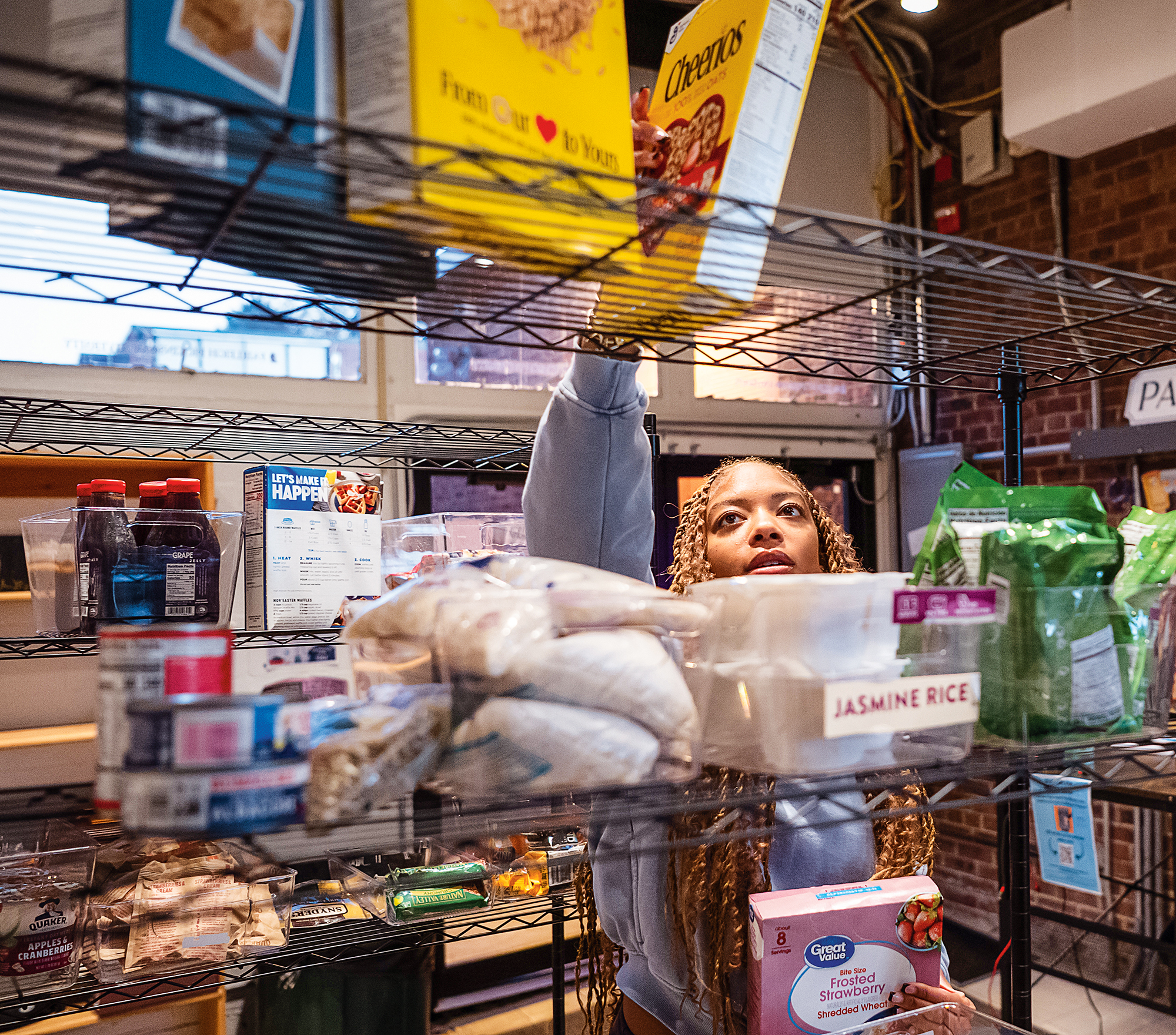
Sophomore biology major Nya Blades volunteers at the Knights Market food pantry. (Photo: Reena Rose Sibayan)
Campus Food Pantries Tackle College Hunger
By Kenna Caprio
Last year, students and other FDU community members visited the food pantries on the Florham and Metropolitan campuses 3,200 times.
Since their inception — the Devils Care Food Pantry opened in 2019, and the Knights’ Market followed in 2020 — both pantries have become indispensable community resources.
“Food pantries are an essential service because food is a right,” says Rashard Mills, director of student union and campus engagement at the Metropolitan Campus. “We want to make sure our students are functioning cognitively, and that when they’re in class, at internships or jobs, or out in the field, that they can absorb information and be the best they can be. That starts with food.”
Thirty-six percent of college students in New Jersey have faced some kind of food insecurity, according to the Spring 2025 Student Food Security Survey released by the New Jersey Office of the Secretary of Higher Education. The survey collected 11,877 responses from students at 32 New Jersey institutions of higher education.

Junior business administration major Dean Joseph arranges a pair of pants during his shift at the Knights’ Market. (Photo: Reena Rose Sibayan)
“So many factors can contribute to food insecurity,” says Tiffany Walker, University director of Student Wellness Services and a licensed clinical social worker. “There’s cost and access. Inflation. Job instability and underemployment. Environmental, systemic and geographic disparities. Transportation barriers. Medical expenses. Health concerns, illnesses, disabilities or substance abuse and recovery challenges.”
But, she continues, FDU can take a communal approach to support people in need.
“It’s important to be honest that some of these challenges do feel insurmountable. There might not be a way to shift some of those larger systems and issues, but there are barriers we can eliminate at our institution,” Walker says. “We don’t want our students to be hungry. We’re committed to that.”
Inside of the food pantries, visitors will find perishable and nonperishable food options (including snacks and quick meals), personal hygiene products, cleaning products, household items, books, clothing, bedding and office and school supplies.
Both pantries operate from 10 a.m. to 4:30 p.m., Monday through Friday. Community members with a University ID can visit once per day, and take up to a total of four items each day.
The pantries have established partnerships with community resources and businesses, including The Community FoodBank of New Jersey and Stop and Shop grocery store. While most items still come to the pantries through individual donations, the partnerships provide a sustainable food pipeline, ensuring that the campus shelves are always full.

“We don’t want college students to have to decide between paying tuition or buying groceries,” says Rashard Mills, director of student union and campus engagement
at the Metropolitan Campus. (Photo: Reena Rose Sibayan)
The Community FoodBank of New Jersey sends out a list of available staple foods to their partners to pick from. Partners select items and then arrange a pickup at their warehouse. The Community FoodBank is a food storehouse and distribution facility that supplies pantries and other nonprofits with food and other goods.
Stop and Shop supplied the University with a $5,000 grant in 2024, which the store delivered in gift cards. If students have a specific food or item request, volunteers can note that and pick it up with a gift card on a shopping trip
Many students come to the pantries for snacks and ready-to-eat items like ramen, cereal, canned goods, snacks, pizza rolls, and Hot Pockets. But, others request flour and baking ingredients.
People can also pick up perishable items at the pantries. Thanks to a grant that Mills spearheaded, the pantries were able to purchase refrigerators and freezers. Community members can donate fresh food as long as the products haven’t been opened, items have visible expiration dates and the pantry is open to receive the donation.
The University is confronting food insecurity in other ways, too. Aramark, the food service provider on the New Jersey campuses, donates 500 meal swipes per year to students in need at FDU. Through the office of Housing and Residence Life and Student Wellness Services, students can get information about SNAP, the Supplemental Nutrition Assistance Program.
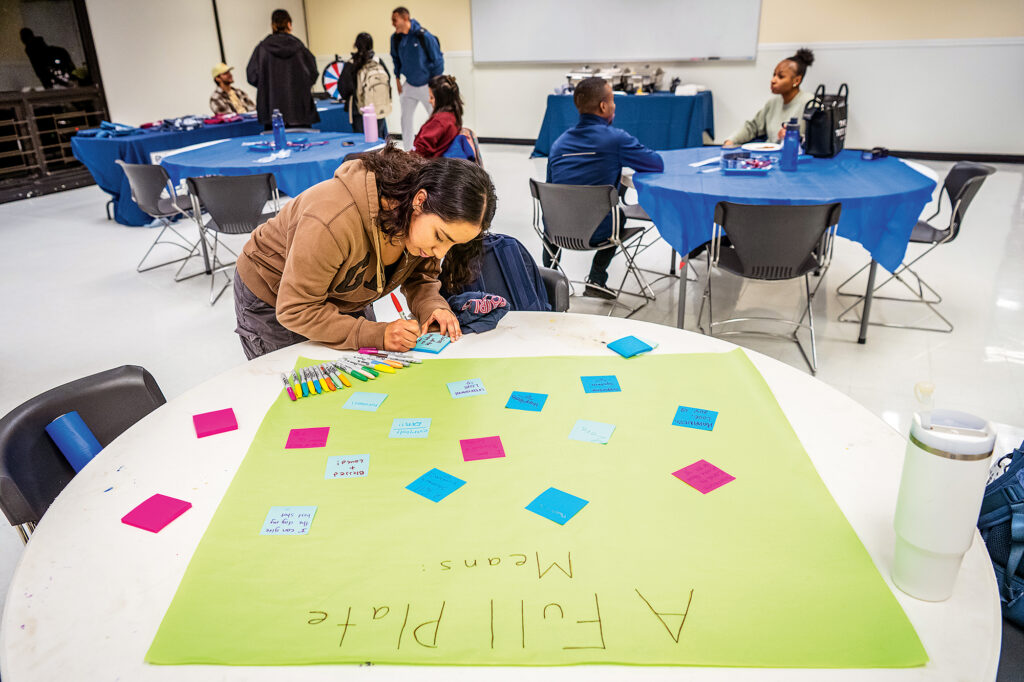
At an event highlighting food insecurity, a student adds her thoughts on what a full plate means. (Photo: Reena Rose Sibayan)
Educating the community is an important part of reducing hunger.
“There are misconceptions that hunger looks a certain way,” says Walker. “But hunger is invisible. People who are going hungry often appear stable, but a lack of sufficient nutrition impacts sleep and cognition. Without proper nutrition, people can experience fatigue, delayed processing, confusion, headaches, dry mouth or dizzy spells. We need energy to labor physically, mentally and emotionally.”
At Student Wellness Services, the staff use a holistic model to support their patients.
“Case management and referral services are part of our work,” Walker says.
Stigma can also be a barrier to accessibility. Pantry volunteers try to make the process as smooth and as noninvasive as possible, simply requiring visitors to sign in and show their University ID, no other questions asked.
Both privacy and comfort are important elements to reducing stigma.
The pantry also hosts events like movie or trivia nights to welcome and educate the community in fun ways. Spreading awareness about food insecurity in interesting, informative and casual ways, can reach students and community members who might not know about the issue — because they haven’t personally experienced it — and get them on board to provide support without judgment.
For additional information about volunteering, accessing or donating, email knightsmarket@fdu.edu or devilscarepantry@fdu.edu, or find and follow the pantries on Instagram at @fduknightsmarket and @fdu_devilscarepantry. Both pantries are managed by Housing and Residence Life.