Dr. Doolittle 2.0
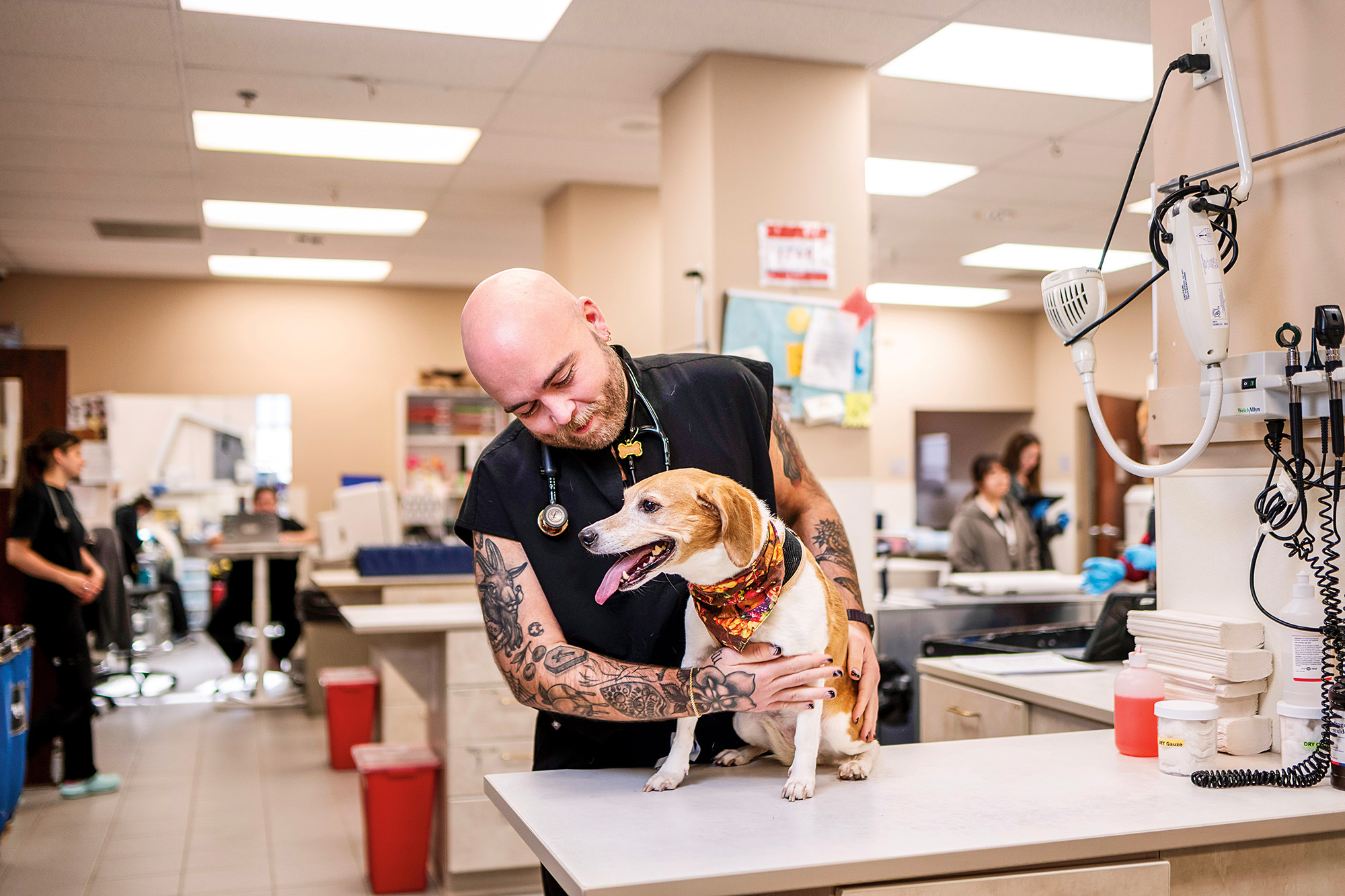
(Photo: Karsten Moran)
Daniel Ruvolo, BS’16 (Flor)
By Mary Ann Bautista
Over the years, emergency critical-care veterinarian Daniel Ruvolo, BS’16 (Flor), has treated a tapir, a beluga whale, a jaguar, a penguin and a red tail boa snake.
Drawn to medicine, science and animals from a young age, he always wanted to become a veterinarian. “I never saw myself doing anything else,” he says.
Ruvolo pursued his passion with determination, following his father’s advice to “Suffer today for tomorrow.” He went on a decade-long educational journey — four years as a biology major at FDU, two years for his master’s degree at Rutgers University and another four years for his doctorate at Cornell University. It’s a demanding and rigorous path, replete with personal sacrifice, but also incredibly fulfilling, he says.
Since 2023, Ruvolo has specialized in emergency critical care at Oradell Animal Hospital in Paramus, N.J. His days are never the same and a standard nine-hour shift one day can run up to 16 hours — with no breaks — the next.
“I never know what type of emergency or animal will walk through the hospital doors,” he says. “I can go from managing a cat with a urinary obstruction and treating a parrot for regurgitation to taking a dog to surgery for internal bleeding.”
His cat Olive continues to be Ruvolo’s most memorable patient. As third-year veterinary students at Cornell and with supervision from board-certified surgeons, candidates perform their first complete spay surgeries (ovariohysterectomies). All the cats getting surgery are shelter cats that also need homes.
“When I went in to pick my surgery patient, I fell in love with Olive and wound up adopting her,” he recalls. “She looked very ill because of a uterine infection (pyometra). So, my first surgery, instead of being straightforward, was more complicated and critically important. However, the surgery went well, and Olive recovered without any issues!”
For Ruvolo, working with critically ill animals and their families can be taxing.
“The medicine itself continues to be exciting and challenging,” he explains, “but you also contend with compassion fatigue and burnout. You take a lot of the grief and sadness home with you, which is why having a strong support system is really important,” he adds. “You need to be empathetic and caring, without being too overly invested, because the weight would be too heavy to carry.”
Fortunately, the good days almost always make up for the bad days. “Seeing a patient go from being critically ill to leaving the hospital purring or with their tail wagging and witnessing a family’s excitement when they pick up their pet makes all of the stress worth it,” he says.
PET BFFS
“Olive, an eight-year-old cat, whom I adopted after performing my first-ever surgery on her; Brennan, a corn snake who’s 14; and Nagini, a ball python who’s 5.”
FDU BROTHERS
“Joining Alpha Kappa Lambda was the best decision I made. I’ve kept in touch with a lot of my fraternity brothers and with [senior lecturer] JR Pinto, who was our faculty adviser.”
VET ADVICE
Get pet insurance! “It’s an added expense, but it really does make a big difference.”
DOWN TIME
To destress, he visits the beach, goes on runs, visits local breweries and vineyards, reads and binge-watches TV shows and enjoys his Pokémon card collection.