CoNAH Experiential Learning
What is Experiential Learning?
At Fairleigh Dickinson University’s College of Nursing and Allied Health, students do not learn healthcare only from textbooks. They learn by practicing, observing, reflecting, and applying what they know in realistic and real-world settings.
Experiential learning is often described as “learning by doing.” For CoNAH students, this means connecting classroom knowledge to patient care, clinical judgment, communication, technology, teamwork, and service. These experiences are intentionally built into our nursing, allied health, and respiratory care programs so that students develop the confidence, competence, and professional habits needed for today’s healthcare environments.
Clinical Rotations
Clinical rotations give students the opportunity to learn in actual healthcare settings under faculty supervision and in partnership with clinical agencies. Depending on the program and course, students may be assigned to acute care hospitals, subacute care centers, community-based settings, or other approved healthcare environments.
Clinical experiences are selected to align with course content and student learning outcomes. For example, students studying adult health, pediatrics, behavioral health, community health, or respiratory care may be placed in settings that support those learning goals. These experiences help students build clinical reasoning, communication skills, professionalism, and an understanding of how healthcare teams work together to care for patients and families.
Students are responsible for transportation to assigned clinical and experiential learning sites. Clinical sites are located throughout the region and may require commuting from campus. Students must also meet all clinical-agency requirements, including health, safety, onboarding, parking, and professional conduct expectations. Students should also expect travel between campus labs. (See CoNAH Student Manual – Clinical Issues.)
CoNAH maintains clinical affiliations with many healthcare organizations across the region. Our clinical affiliations include the following agencies, among many others:
- Atlantic Health System (e.g., Overlook Medical Center, Morristown Medical Center, Newton Medical Center, Hackettstown Medical Center)
- Valley Health System (e.g., The Valley Hospital)
- Hackensack Meridian Health (e.g., Hackensack University Medical Center, Carrier Clinic, JFK Medical Center, Jersey Shore University Medical Center, Mountainside Medical Center)
- Englewood Health
- Holy Name Medical Center
- RWJ Barnabas Health (e.g., Children’s Specialized Hospital, Clara Maass Medical Center, Jersey City Medical Center, Robert Wood Johnson University Hospitals)
- University Hospital of Newark
ChartSmart Lab: Health Technology, Telehealth, and Medication Calculation and Safety
The ChartSmart Lab, located in Dickinson Hall on the FDU Metropolitan Campus in Teaneck, is designed to help students build confidence with the technologies and safety practices used in contemporary healthcare environments.
In this lab, students participate in learning experiences related to electronic health record use, virtual care, and medication calculation and safety. These experiences may include Epic Lyceum programming, Caregility virtual health programming, dosage calculation practice, medication-safety exercises, and activities that help students connect accurate calculation, safe verification, appropriate administration, and documentation.
The goal of the ChartSmart Lab is not simply to teach students how to use technology. It is to help students use technology thoughtfully, accurately, and intentionally to support safe care, sound clinical judgment, and meaningful connection with patients and families.
Electronic Health Record Training (Epic Lyceum Program)
Healthcare professionals must be able to use technology while remaining attentive to the human needs of patients and families. Through CoNAH’s electronic health record learning experiences, including the Epic Lyceum Program, students develop familiarity with the electronic health record and learn how documentation, information retrieval, clinical workflows, and communication support safe patient care.
A major focus in our CoNAH healthcare programs is on developing student capacity to adeptly navigate the electronic health record so that they are able to use this technology with ease and intentionality to strengthen connection with their future patients and/or enhance their healthcare experience. Our goal is not simply for students to “use the computer.” Electronic health record learning activities occur in the ChartSmart Lab and are designed to help students understand how health information technology supports clinical reasoning, safety, continuity of care, and professional communication.
Telehealth Training (Caregility Virtual Health Program)
Healthcare is increasingly delivered through virtual and hybrid models of care. CoNAH students are introduced to telehealth and virtual care competencies through learning experiences that help them communicate professionally, assess patient needs, use technology appropriately, and understand the role of virtual health in expanding access to care.
Through experiences such as the Caregility Virtual Health Program, students begin to develop the skills needed to provide compassionate, effective, and patient-centered care in technology-enabled environments. These learning experiences are supported through the ChartSmart Lab.
Medication Calculation and Safety
Medication safety begins long before a medication is administered. Students must learn to calculate accurately, recognize unsafe doses, verify orders, understand medication-administration processes, document correctly, and communicate concerns when something does not seem right.
CoNAH’s Medication Calculation and Safety curriculum is designed to help students strengthen these essential competencies through guided practice, educational software, NCLEX-style medication-calculation questions, hands-on learning materials, and realistic medication-administration scenarios. By connecting calculation, verification, administration, and documentation, students learn that medication math is not just an academic requirement; it is a patient-safety responsibility.
Medication Calculation and Safety learning activities are supported through the ChartSmart Lab in Dickinson Hall.
Skills Laboratories
Skills laboratories provide structured, hands-on learning environments where students practice foundational and program-specific clinical skills before and during clinical placement. CoNAH students may participate in skills laboratory experiences at Dickinson Hall on the FDU Metropolitan Campus in Teaneck and at Park Avenue Plaza, 230 Park Avenue, Florham Park.
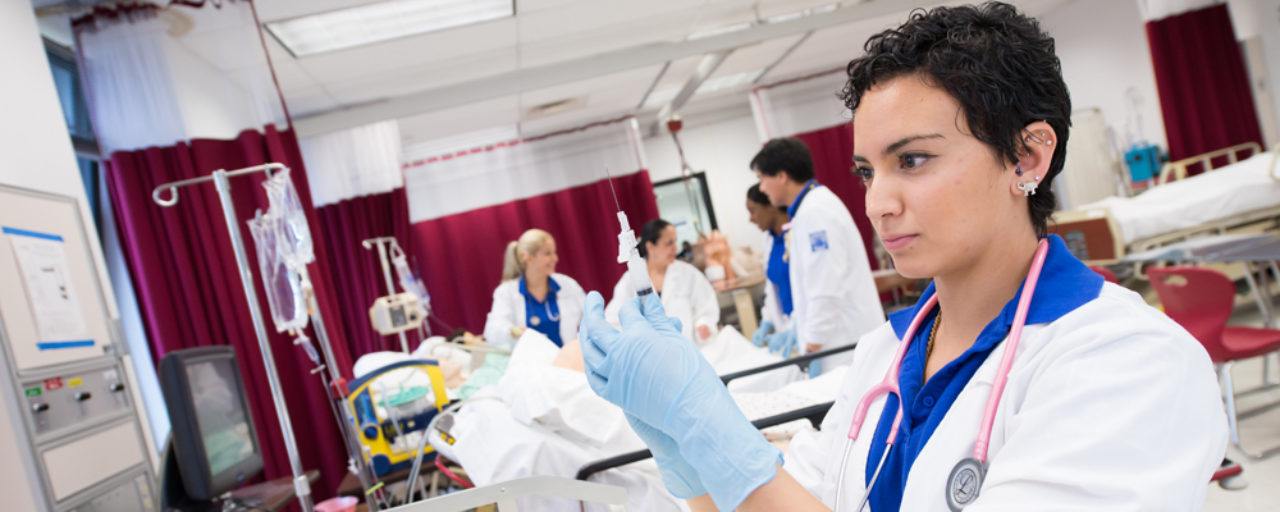
Skills lab experiences may include health assessment, vital signs, patient-care techniques, mobility and safety skills, medication-related skills, respiratory care skills, and other course-aligned competencies. These experiences allow students to practice techniques, receive feedback, build confidence, and prepare for clinical and simulation experiences.
Students should expect that some skills laboratory activities may require travel between campuses.
Acute Care Skills Laboratory
Our acute care skills laboratory was established in 2026, coincident with the opening of our Respiratory Care Program. The acute care laboratory provide a hands-on learning environment where students practice “intensive care” skills, such as working with ventilators and oxygen, and inserting intravenous and intra-arterial lines, before and during associated clinical placements. CoNAH students participate in acute care skills laboratory experiences at Dickinson Hall on the FDU Metropolitan Campus in Teaneck.
High-Fidelity Simulation Laboratories
High-fidelity simulation gives students the opportunity to apply knowledge and skills in realistic patient-care scenarios without risk to actual patients. CoNAH’s high-fidelity simulation laboratories are located at Park Avenue Plaza, 230 Park Avenue, Florham Park.
In simulation, students may care for realistic patient manikins, respond to changing patient conditions, practice communication and teamwork, and participate in debriefing after the scenario. These experiences help students strengthen clinical judgment, prioritization, patient safety, delegation, communication, and professional role development.
High-fidelity simulation also includes INTERPROFESSIONAL learning experiences with students from nursing, respiratory therapy, physician assistant studies, occupational therapy, pharmacy, and other health-related programs. These activities help students understand professional roles and practice the team-based communication needed for achieving a complex patient care goal.
Community Immersion
Healthcare does not happen only in hospitals. CoNAH students also learn in community settings where prevention, education, access, advocacy, and health promotion are essential.
Community immersion experiences help students understand the social, environmental, and behavioral factors that influence health. Nursing students participate in health fairs, food pantries, Head Start and WIC-related programs, blood drives, vaccine clinics, wellness education activities, and other community-based initiatives.
These experiences help students see the broader role of healthcare professionals in promoting population health, reducing barriers to care, and supporting healthier communities. Students may also develop wellness leadership skills through FDU’s LiveWell Warriors Peer Health Educator programs.
Advanced Practice and Leadership Experiences
Graduate students choose to study either advanced practice nursing (APN) or healthcare leadership. Experiential learning at the graduate level is tailored to meet the individual educational needs and certification requirements of students.
APN students participate in planned clinical practice experiences that afford them the opportunity to develop professional competencies and to integrate new knowledge in practice settings that are aligned with their population concentration. Preceptors (including nurse practitioners, physicians, and other qualified providers) support students in a broad range of settings (e.g., private offices, health care clinics, telehealth, long term care settings) to ensure that students will develop competencies to function as members of interprofessional teams.
APN students can choose from sites that are in our large portfolio of clinical affiliation agreements with healthcare systems or can identify an alternative clinical site, in collaboration with faculty, and develop a clinical learning experience through a letter of agreement with the clinical site. FDU also maintains cooperative agreements that support APN clinical opportunities in other states, including New York. APN students must hold an RN license in the state where they are requesting a clinical placement. (See important Title IV Professional License Disclosure documents and CoNAH Student Manual – Clinical Issues.)
Graduate students who work in a healthcare facility that has a clinical affiliation agreement with FDU are eligible to receive a tuition discount. Graduate healthcare students who are interested in establishing a clinical affiliation agreement between FDU and a healthcare facility (to either obtain the tuition discount or as a clinical site) should contact their Program Director or Track Director for guidance.